Free Printable Lithium Battery Label Guide (USA) – Looking for a free printable lithium battery label for shipping in the USA? Lithium battery labels (and marks) are essential safety tools required under U.S. Department of Transportation (DOT) Hazardous Materials Regulations. They help carriers identify packages containing lithium-ion or lithium-metal cells and batteries so they can be handled correctly and reduce fire risks during transport by ground, air, or vessel.
This resource page explains the key labels and marks, current U.S. requirements, and points you to legitimate free official guides that include clear illustrations and examples you can reference or print for personal use. Always verify that any printed label meets size, color, durability, and placement rules before shipping—paper printouts from a home printer are often not sufficient for commercial or regulated shipments.
Why Lithium Battery Labels Matter?
Lithium batteries are Class 9 miscellaneous hazardous materials because they can overheat, short-circuit, or catch fire if damaged, improperly packaged, or mishandled. The Pipeline and Hazardous Materials Safety Administration (PHMSA) regulates them under 49 CFR Parts 171–180. Proper labels and marks communicate the hazard so packages receive correct handling.
Common elements include:
- The Class 9 lithium battery hazard label (diamond-shaped with a battery symbol).
- The lithium battery mark (rectangular or square with red diagonal hatching and the applicable UN number).
- Cargo Aircraft Only (CAO) labels when required for air shipments.
- UN numbers such as UN3480 (lithium-ion batteries), UN3481 (lithium-ion contained in or packed with equipment), UN3090 (lithium-metal batteries), and UN3091 (lithium-metal contained in or packed with equipment).
Requirements differ by battery size (watt-hour rating or lithium content), configuration (standalone, packed with equipment, or contained in equipment), and mode of transport. Recent updates removed the telephone number requirement from the lithium battery mark (phase-out ends December 31, 2026).
Official Free Resources with Label Examples and Guidance
The most reliable free resources come from government and specialized training sites. These provide up-to-date compliance information, diagrams of required marks and labels, and scenario-based shipping guides rather than ready-to-peel commercial stickers.
Start with the official PHMSA Lithium Battery Guide for Shippers (revised October 2024). It covers packaging, hazard communication, marking, and labeling for all modes according to the latest rules (including HM-215Q changes). Download the free PDF guide here:
PHMSA Lithium Battery Guide for Shippers
Direct PDF: Lithium-Battery-Guide-2024.pdf
Another excellent free summary is the HAZMATEAM Lithium and Sodium Ion Battery Shipping Guide. It consolidates classification, package marks/labels, documentation, and packaging requirements for ground (49 CFR), air (IATA), and vessel (IMDG), with updates for 2025–2026. Download it free from their site:
HAZMATEAM Free Lithium Battery Shipping Guide
For air-specific information, check FAA lithium battery resources, which link to interactive guides and PHMSA materials:
FAA Lithium Battery Resources
U.S. Postal Service rules appear in Publication 52 (Hazardous, Restricted, and Perishable Mail). Domestic mailability, quantity limits, and marking requirements for lithium batteries (including surface-only restrictions in many cases) are detailed there:
USPS Publication 52
These sources show exact label designs, minimum sizes (typically 100 mm × 100 mm for the lithium battery mark, reducible in limited cases), color requirements (red hatching, black symbol on white or contrasting background), and when each mark or label is needed. Use the illustrations as reference when creating or ordering compliant labels.
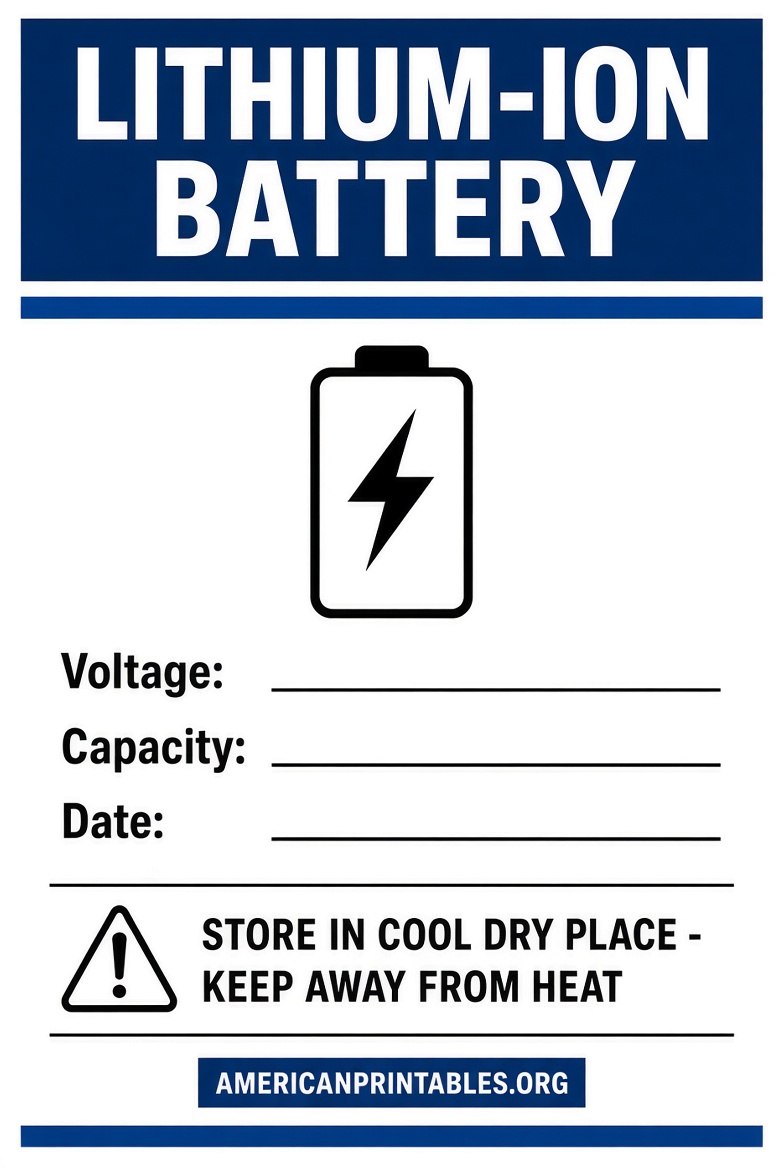
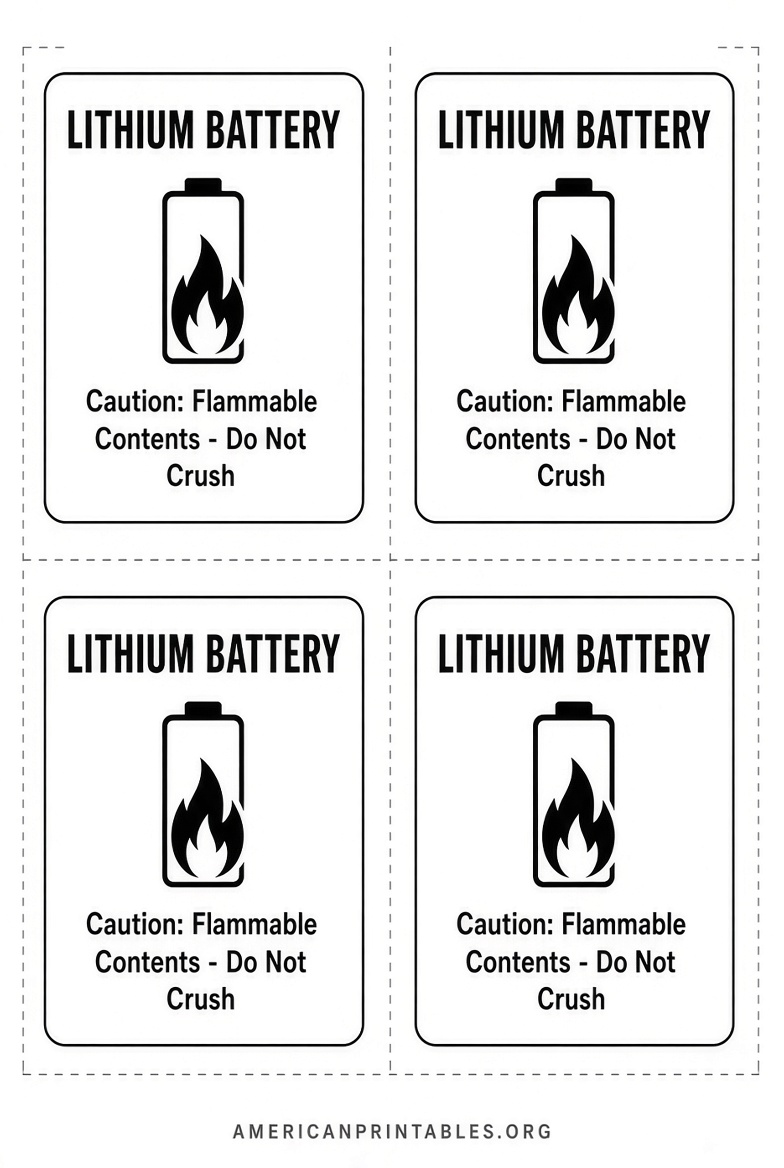
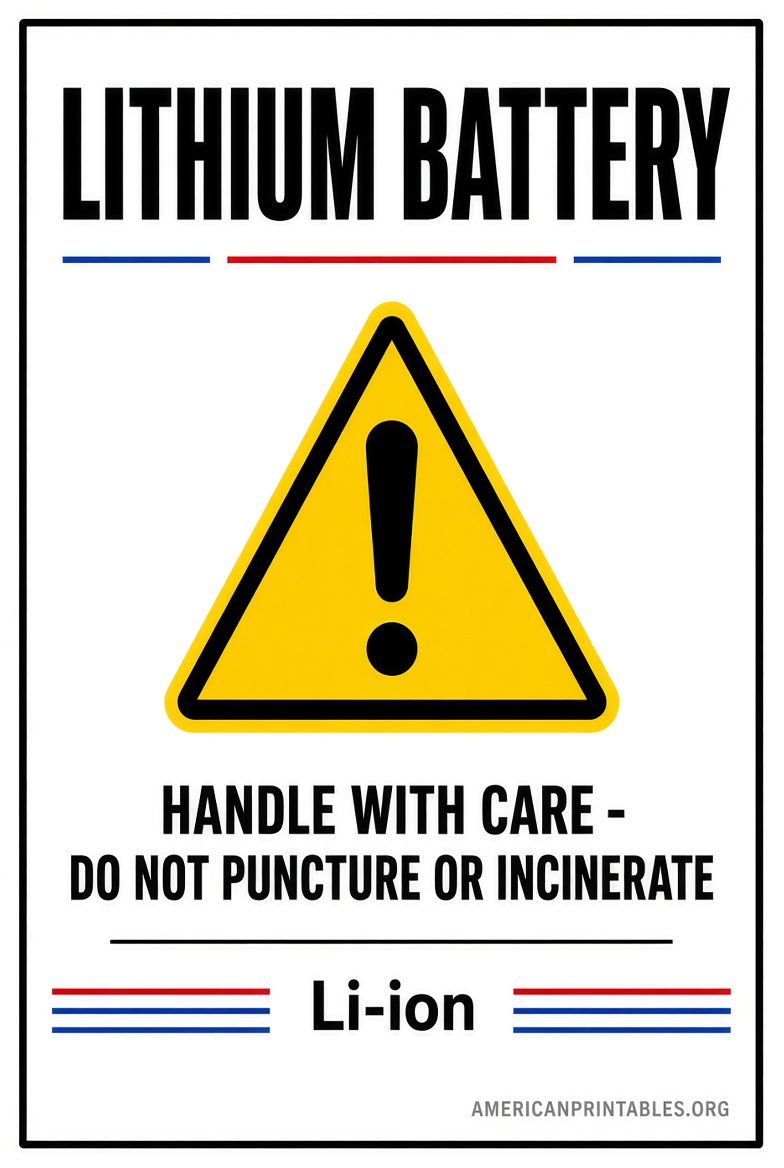
Free Printable Lithium Battery Label Guide (USA)
Practical Tips for Using or Printing Labels
- Identify your battery type, watt-hour rating (or lithium content), and configuration first. This determines the UN number and which marks/labels apply.
- Confirm mode of transport. Air shipments are the strictest; many standalone lithium-ion batteries are cargo-aircraft only and subject to state-of-charge limits.
- Print or order durable adhesive labels that meet durability standards. Home-printed paper versions may peel, fade, or fail inspection.
- Place marks and labels on a contrasting background on the outer packaging so they are clearly visible. Follow orientation and size rules in the guides.
- Keep records of UN 38.3 test summaries for the cells/batteries when required.
- When in doubt, contact the PHMSA Hazardous Materials Information Center at 1-800-467-4922 or check with your carrier (UPS, FedEx, USPS, etc.), as carriers often impose additional restrictions.
Free official guides give you the accurate designs and rules so you can source or create compliant labels. Commercial suppliers offer pre-printed, weather-resistant versions that many shippers prefer for reliability.
Brief FAQ
Do I always need a free printable lithium battery label?
Not every small consumer device requires full labeling. Exceptions exist for very small quantities or batteries contained in equipment under certain limits, but you must still meet packaging and documentation rules. Always check the current PHMSA guide for your specific case.
Can I just print any image I find online?
Only if it exactly matches the official design, dimensions, colors, and content requirements. Many random “free printable” images online are outdated or incorrect. Stick to the illustrations in the official PHMSA and HAZMATEAM guides.
Are free printed labels accepted by carriers?
Carriers and inspectors look for compliance with regulations, not the source of the label. Durability and accuracy matter most. For frequent or commercial shipping, professional labels are recommended.
Where can I get more help?
Use the free PHMSA and HAZMATEAM guides linked above, contact the PHMSA Information Center, or consult your carrier’s lithium battery shipping pages. Training may also be required for hazmat employees.
Proper labeling protects everyone in the supply chain. Start with the official free guides, confirm the exact requirements for your shipment, and apply accurate, durable marks and labels. Safe shipping starts with the right information.