Free Printable Squirrel House Plans for US Backyards – A squirrel house — also called a squirrel nest box or den box — is a simple wooden shelter that gives gray squirrels, fox squirrels, and other tree squirrels a dry place to nest, raise young, and wait out winter storms. In many U.S. neighborhoods, mature trees no longer have enough natural cavities. A well-built box fills that gap.
This page is a practical resource for homeowners who want printable squirrel house plans, not craft templates of cartoon squirrels. Below you will find standard dimensions used by wildlife agencies, materials that last outdoors, placement rules that actually get boxes used, and direct links to free, legitimate plan PDFs.
A typical backyard squirrel house is a tall, enclosed wooden box with a 3-inch entrance, a sloped roof, drainage holes, and no perch.
What Printable Squirrel House Plans Should Include?
A useful plan is a cut list and drawing you can print on letter-size paper and take to the shop or garage. Look for:
- Exact board sizes for front, back, sides, floor, and roof
- Entrance-hole diameter and height above the floor
- Drainage and ventilation hole locations
- A hinged or removable roof or side for cleaning
- Mounting guidance for a tree trunk
If a page only offers coloring-page squirrel outlines, it is not a house plan. Paid Etsy “digital downloads” can be fine if you want a fancy design, but you do not need to buy plans. Several public agencies and habitat groups already publish free versions.
Standard Squirrel Nest Box Dimensions
Wildlife agencies across the eastern and midwestern United States use a similar box for eastern gray squirrels and fox squirrels. Purdue Extension’s backyard-wildlife guide lists an 8-by-8-inch to 9-by-9-inch floor, a box height of about 14 to 16 inches, and a 3-inch entrance.
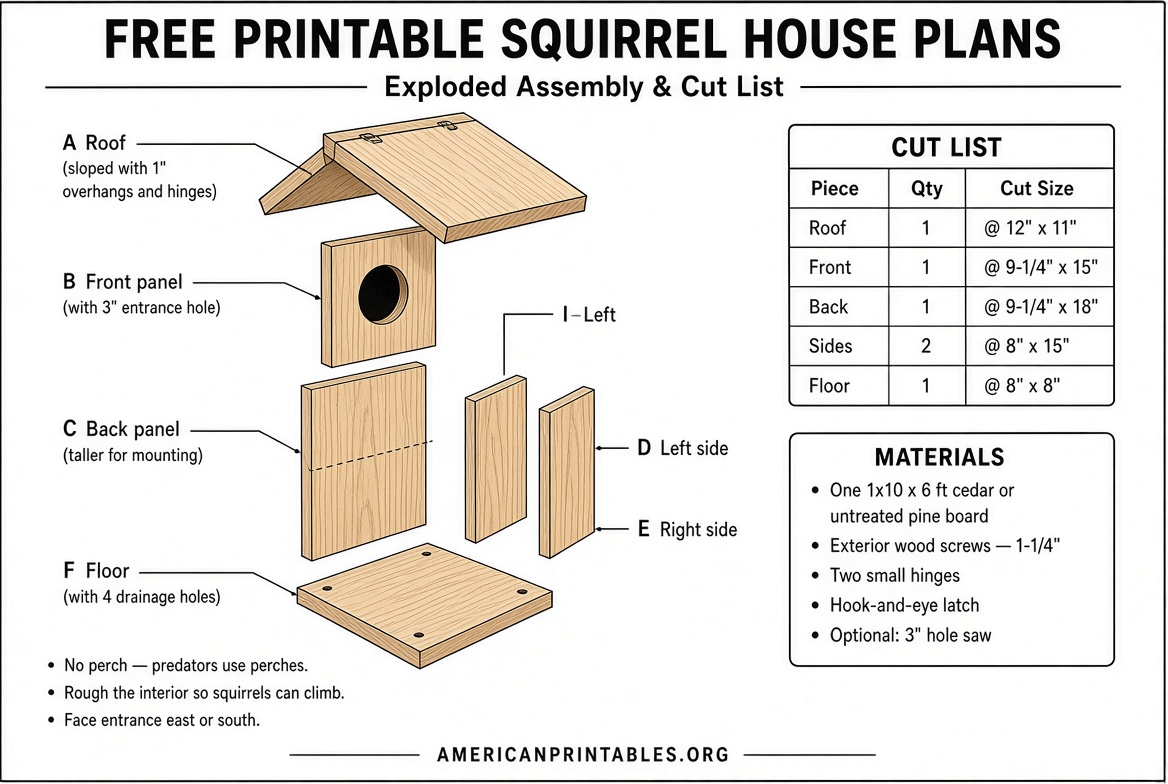
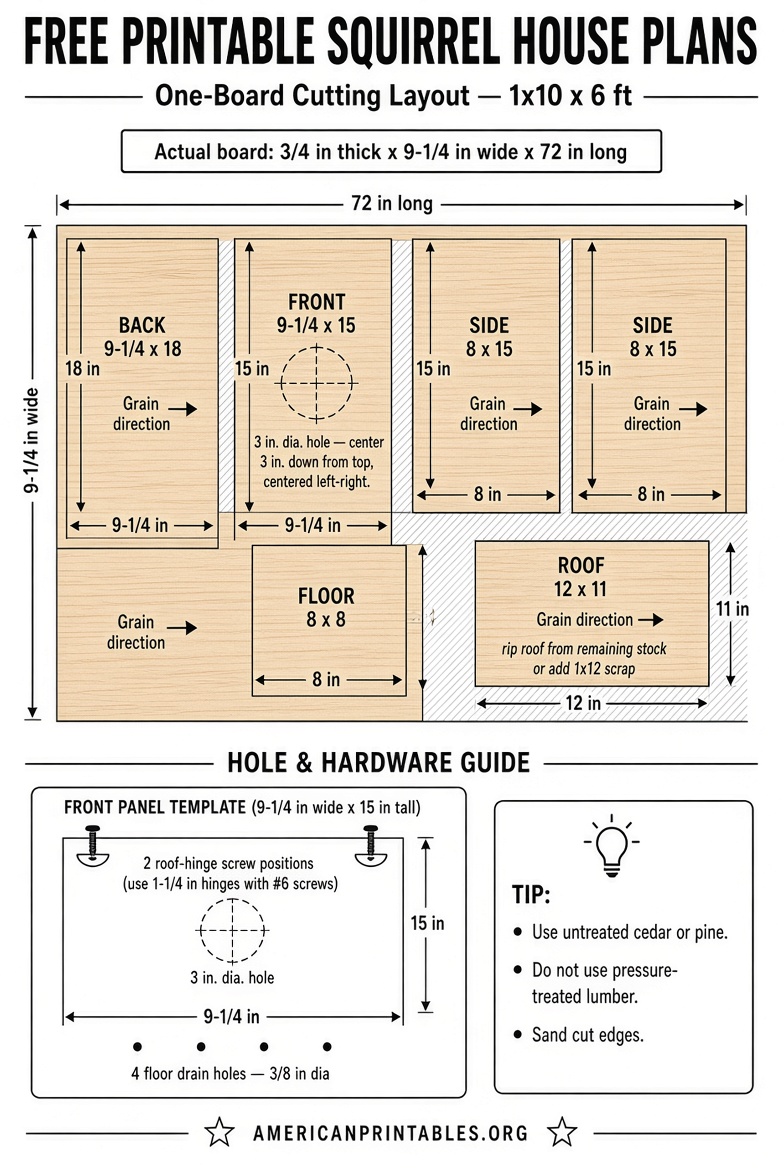
A widely used backyard cut list looks like this:
| Piece | Typical size | Notes |
|---|---|---|
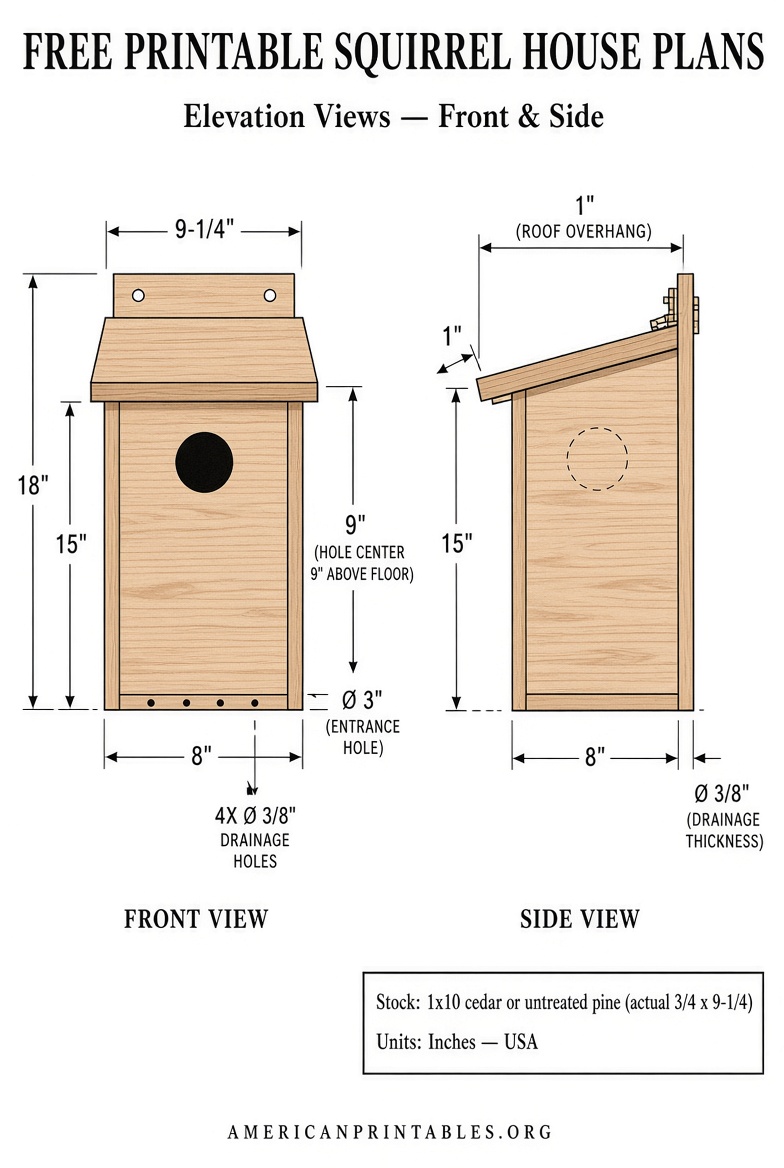
| Front | 9.5″ × 15″ | 3″ entrance hole, 8–9″ above the floor |
| Back | 9.5″ × 18″ | Extra length for mounting to the tree |
| Sides | 8″ × 15″ (2) | Add ventilation holes near the top |
| Floor | 8″ × 8″ | Drill drainage holes in the corners |
| Roof | 11″ × 12″ | Overhang on the front and sides |
Interior height of 12–15 inches keeps the cavity compact enough to hold heat in winter. Wood should be ¾ inch to 1 inch thick. Do not add an outside perch. Predators use perches; wild cavities do not have them.
Match the hole to the species. Eastern gray and fox squirrels need about a 3-inch round hole. Red squirrels and flying squirrels need a smaller opening (often 1¼ to 2½ inches). A flying-squirrel box is a different plan, not a scaled-down gray-squirrel box.
Where to Get Free Printable Squirrel House Plans?
These five resources are free to download or print. Each link opens in a new tab. None of them require payment for the plan itself.
1. Printable one-page squirrel house PDF (cut list and diagram)
Download the free letter-size plan with front, back, side, floor, and roof measurements, plus an assembled view:
Printable Squirrel House Plans PDF
The same site also walks through placement, wood choice, and cost (usually under $25 in cedar or untreated pine) in its full squirrel-house guide:
Squirrel House Complete Guide
2. Ohio Division of Wildlife nest box booklet
Ohio’s official Nest Box Plans (Publication 419) includes a gray and fox squirrel nest box along with placement rules used by state wildlife staff:
Ohio DNR Nest Box Plans (PDF)
3. Updated 2025 squirrel nest box plans
This current printable set uses one 1-by-10-inch by 8-foot pine board, a 3-inch hole saw, an interior shelf under the entrance, a hinged lid, and a safety hook:
Updated Squirrel Nest Box Plans 2025 (PDF)
4. NC State Extension eastern gray squirrel page
North Carolina’s extension service explains why nest boxes help when den trees are scarce and shows a layout that cuts a box from one 1-by-10-inch by 8-foot board. Print the page or save the figures before you cut lumber:
NC State Extension: Eastern Gray Squirrel
Those four destinations stay inside the five-link limit and cover both a simple backyard PDF and official state guidance. If a link ever 404s, search the agency name plus “squirrel nest box plans” rather than buying a random listing.
A finished box does not need decoration. A tight roof, a correct hole, and a high mount matter more than burned artwork or pine-cone trim.
Free Printable Squirrel House Plans for US Backyards
Materials and Tools You Will Need
Most free plans start with a single 1-by-10-inch board, 6 to 8 feet long.
Best woods: Untreated cedar, cypress, or exterior-grade pine. Cedar lasts longest outdoors and needs no interior finish.
Avoid: Pressure-treated lumber inside the box (chemicals), thin hobby plywood that delaminates in rain, and metal boxes that overheat.
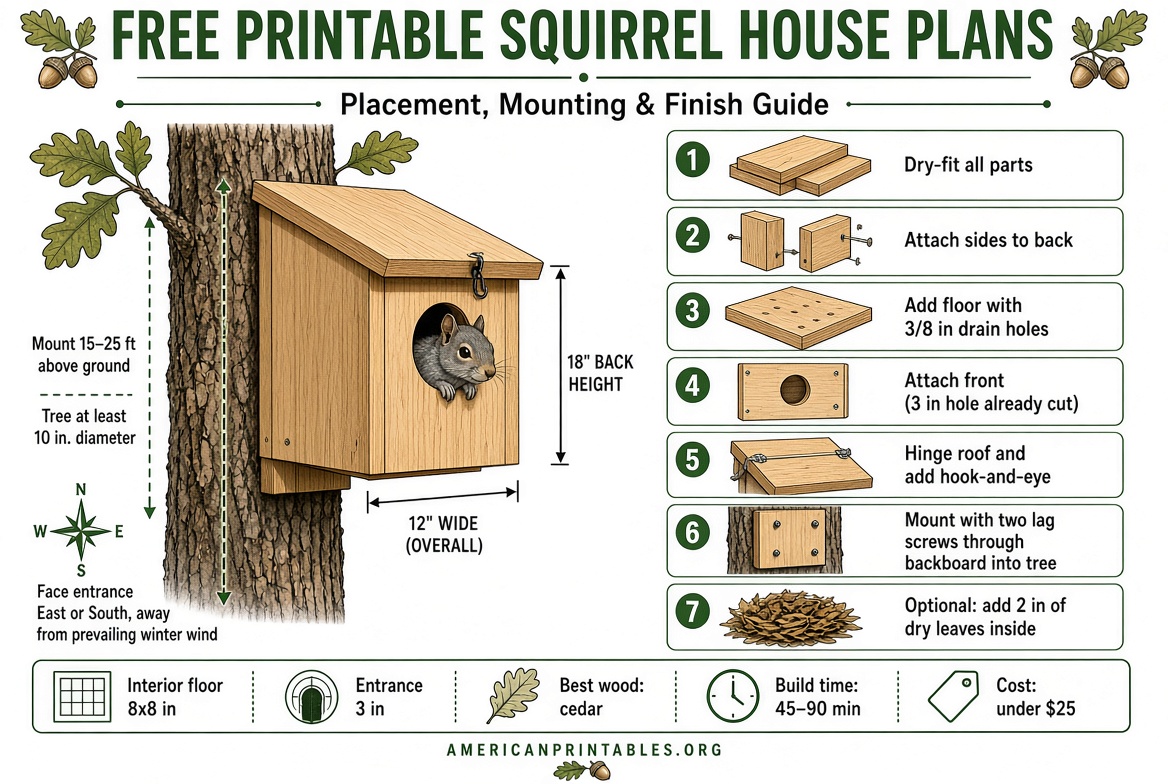
Hardware: Exterior wood screws (about 1⅝ inches), optional 1½- to 3-inch hinges for a clean-out roof, and a hook-and-eye latch. Use lag screws and washers to mount the box so you can loosen them as the tree grows.
Tools: Tape measure, square, saw, drill, 3-inch hole saw (or 2½-inch if your plan specifies that size), sandpaper, and a ladder with a spotter. A 3-inch hole saw is the one specialty bit worth buying.
Expect 30–90 minutes of cutting and assembly once the board is marked.
How to Place a Squirrel House So It Gets Used?
Plans only work if the box is in the right tree.
- Mount 15–30 feet high on a live hardwood at least 10 inches in diameter. Ohio wildlife staff recommend at least 30 feet where it is safe to do so; many backyard builders use 15–25 feet.
- Face the entrance east or south so morning sun warms the box and winter winds hit the back.
- Prefer oak, hickory, maple, beech, or walnut near other mast trees.
- Keep the box off thin limbs cats can climb and away from busy walkways.
- Put two or three boxes on different trees, at least 20 feet apart, instead of clustering them on one trunk.
- Install in late summer or fall. Winter is when squirrels scout dens most heavily.
- Add a shallow layer of dry leaves. Do not stuff the box full.
Do not nail the box tight to the bark and walk away. Loosen lag screws once a year so the trunk can grow.
Building Tips That Prevent Failed Boxes
Print the plan at 100% scale and check one measurement with a ruler before you cut every piece.
Leave the interior rough so young squirrels can climb. A few shallow saw kerfs on the inside of the front wall, just below the hole, help kits reach the exit.
Drill drainage holes in the floor and ventilation holes high on the sides. A sloped or hinged roof should overhang the entrance.
Assemble with screws, not only nails. Squirrels chew; screws stay put longer.
Skip exterior perches and skip interior paint or stain. If you seal the outside, use a non-toxic exterior finish and keep it off the inside surfaces.
Work on the ground, then lift the finished box. High work should be done with a stable ladder and a helper — not from a wobbly step stool.
Care After You Hang the Box
Check the box once a year in late fall or mid-summer, when it is less likely to hold a litter. Remove soaked nesting material, wasp nests, and debris. Replace a thin layer of dry leaves.
If starlings, house sparrows, or bees take over, clean the box and consider a second box farther into cover. A correctly sized 3-inch hole still lets gray squirrels in; it does not keep every other animal out.
A cedar box can last a decade or more. Untreated pine may need replacement in three to five years in wet climates.
FAQ
Are printable squirrel house plans really free?
Yes, if you use agency and habitat PDFs like the ones linked above. Craft “squirrel template” pages and paid woodworking listings are different products.
Will a squirrel house keep squirrels out of my attic?
Sometimes it helps, but it is not a guarantee. Exclusion (repairing eaves, vents, and gaps) is the reliable way to keep squirrels out of a house. A nest box is habitat, not a trap.
Can I use a birdhouse plan?
No. A bluebird house is too small and the hole is too tight for gray or fox squirrels. Use a squirrel-specific cut list.
Do I need a permit?
Building and hanging a nest box on your own property is generally allowed. Relocating or trapping squirrels is regulated and varies by state. Check your state wildlife agency before you move animals.
What if I have flying squirrels?
Use a flying-squirrel plan with a much smaller entrance (about 1¼ inches for southern flying squirrels). Do not assume a gray-squirrel box is “close enough.”
Start With One Printed Page
You do not need a workshop full of tools. Print one of the free PDFs, buy a 1-by-10 cedar or pine board, and cut the five main pieces. Hang the box high on a sturdy hardwood, face the hole away from winter wind, and give squirrels a season to find it.
The most useful printable squirrel house plans are the short official ones: a cut list, a 3-inch hole, drainage, and a tree that can hold the box for years. Start with the one-page PDF and the Ohio or North Carolina guidance, then build to those measurements rather than guessing from a photo.