Free Printable Dosage Calculation Worksheets – Dosage calculation worksheets help nursing students and working nurses practice medication math before it matters at the bedside. A good printable set covers unit conversions, tablet and liquid doses, IV rates, and weight-based problems you will see in U.S. nursing school, clinicals, and NCLEX-style exams.
This page explains what these worksheets include, how to use them, and where to download legitimate free printables from colleges and established nursing education sites.
What Dosage Calculation Worksheets Practice?
Medication math is the process of turning a provider order into a safe amount to give. Worksheets usually start with conversions, then move to real-looking orders.
Common problem types include:
- Metric conversions (mg to mcg, g to mg, L to mL)
- Household conversions used in U.S. practice (lb to kg, oz to mL, tsp to mL)
- Oral tablets and capsules
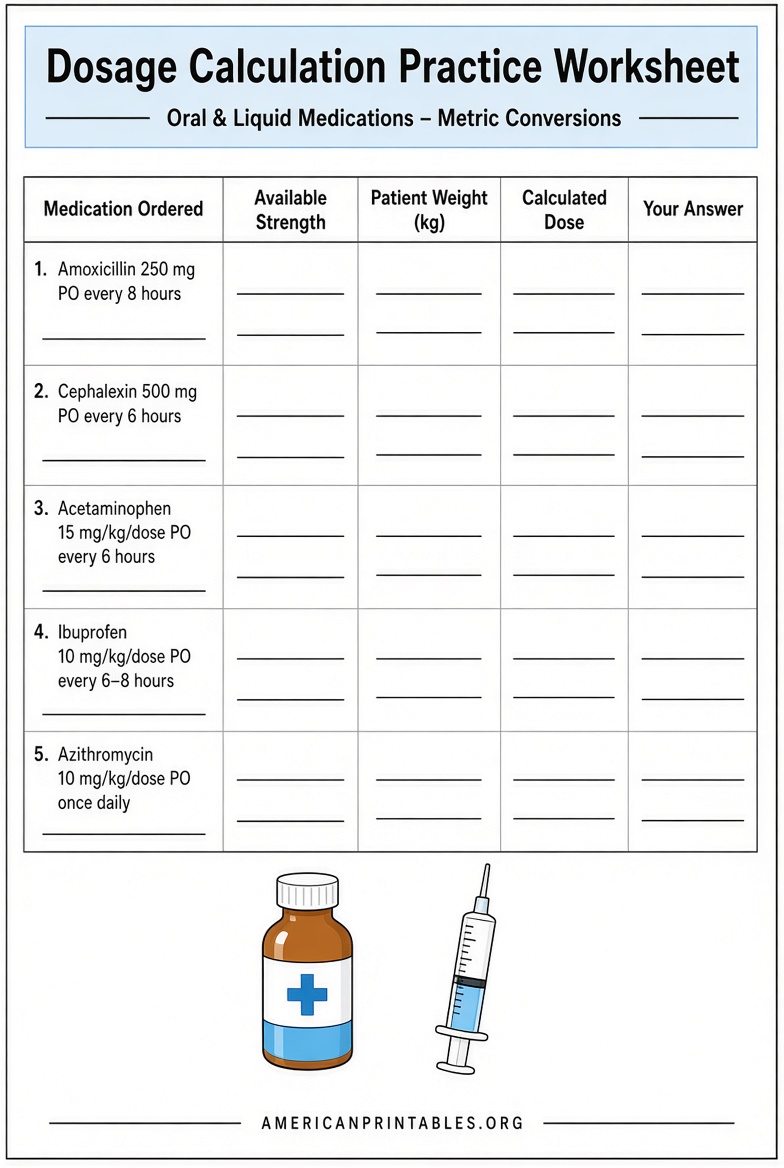
- Liquid oral suspensions
- Injectable (IM, subcutaneous, IV push) volumes
- Reconstitution of powdered medications
- IV pump rates in mL/hr
- Manual drip rates in gtt/min
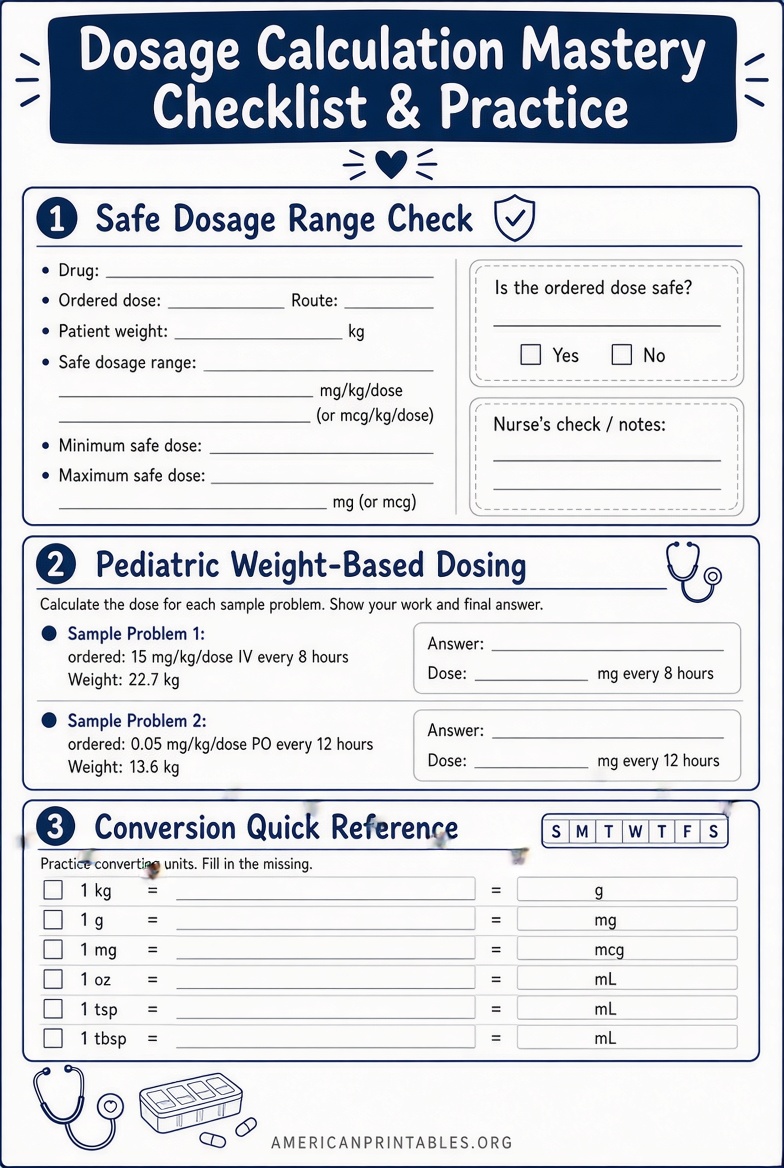
- Weight-based and pediatric safe-dose ranges
- Heparin and other high-alert infusions
Most nursing programs in the United States expect near-perfect accuracy on dosage tests. Practice on paper still helps because exams and skills labs often require you to show your work.
Why Printable Practice Still Matters?
Interactive quizzes are useful. Printed worksheets add something different: you can write out dimensional analysis, check rounding, and review mistakes without a screen.
Use printables when you need to:
- Drill the same skill until the setup is automatic
- Study without Wi-Fi
- Prepare for a timed med-math competency
- Work problems the same way your instructor grades them
Always treat worksheet answers as practice only. Facility policy, current drug labels, and a licensed provider order control what you give to a real patient.
Core Formulas You Will See Again and Again
Most U.S. nursing programs teach one or more of these methods. Worksheets are most useful when you pick one method and stay consistent.
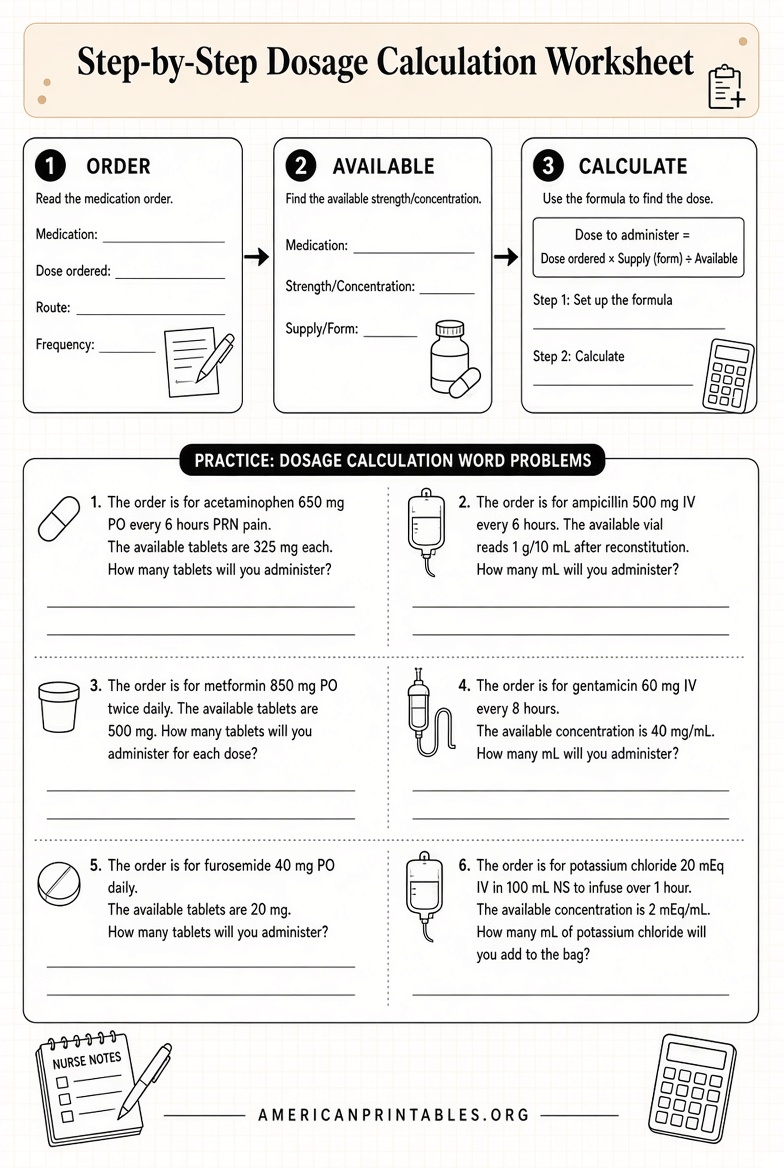
Desired over have (formula method)
[ \frac{\text{Desired dose}}{\text{Dose on hand}} \times \text{Quantity} = \text{Amount to give} ]
Example: Order 500 mg. Available 250 mg per tablet.
[ \frac{500}{250} \times 1 = 2 \text{ tablets} ]
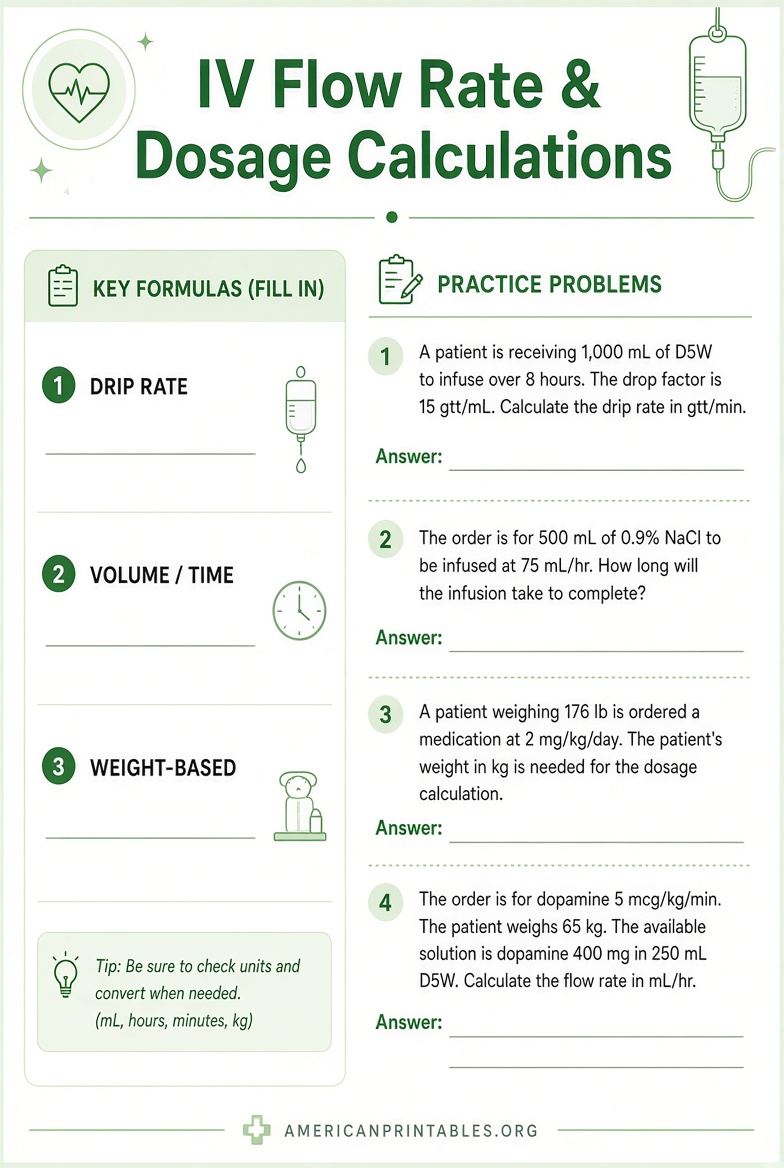
IV pump rate
[ \frac{\text{Total volume (mL)}}{\text{Time (hours)}} = \text{mL/hr} ]
Manual drip rate
[ \frac{\text{Volume (mL)} \times \text{Drop factor (gtt/mL)}}{\text{Time (min)}} = \text{gtt/min} ]
Weight-based dose
Convert pounds to kilograms first ((1 \text{ kg} = 2.2 \text{ lb})), then multiply by the ordered mg/kg or mcg/kg dose.
Dimensional analysis uses the same numbers. You set up conversion factors so units cancel until only the unit you need remains. Many students prefer it for multi-step IV and pediatric problems.
Where to Get Free Printable Dosage Calculation Worksheets?
These sources are free to access, come from colleges or well-known nursing educators, and include practice problems you can print. Confirm each file still opens before you assign it to a class.
1. RegisteredNurseRN video worksheets
Nurse Sarah’s site hosts a set of free PDF worksheets that match her dosage-calculation videos. Topics include basic conversions, oral medications, IV bolus, drip factor, infusion rate, weight-based dosing, pediatric safe dose, and infusion time.
Download the worksheet list here: RegisteredNurseRN dosage and calculations worksheets
2. Community college practice sheet with answer key
Nash Community College posts a 10-question practical nursing worksheet covering IM volume, household fluid limits, liquid units, mg-to-mcg conversion, tablets, insulin, IV pump rate, gtt/min, and lb-to-kg conversion. An answer key is on the same PDF.
Open the printable PDF here: NCCC dosage calculation worksheet (PDF)
3. College tutoring handout library
Indian River State College’s tutoring center keeps a large public repository of nursing math handouts. You can print oral dosage sheets, injectable calculations, reconstitution-with-label practice, IV and heparin problems, pediatric drug calc, and exam-style reviews.
Browse the free handouts here: IRSC Health Science Handout Repository
4. Free open textbook with practice sets
Nursing Dosage Calculations from WisTech Open is a Creative Commons textbook written for nursing and health students. It covers conversions, ratio-proportion, formula method, dimensional analysis, oral and parenteral doses, IV calculations, and mcg/kg/min drips. You can read it online or download a PDF to print selected practice sections.
Access the free book here: WisTech Open Nursing Dosage Calculations
5. Open RN math chapter on NCBI
The Open RN Nursing Skills textbook, hosted by the National Library of Medicine, includes a full math-calculations chapter with conversions, dimensional analysis, liquid concentrations, reconstitution, weight-based dosing, and IV problems. It is not a single “worksheet packet,” but the practice problems print well for study sessions.
Read the chapter here: Open RN Chapter 5: Math Calculations
Avoid random “printable worksheet” blogs that scrape other people’s problems and wrap them in ads. Prefer .edu files, open textbooks, and educator sites that show who created the material.
Free Printable Dosage Calculation Worksheets
How to Use a Worksheet the Right Way?
Print one topic at a time. Do not jump from pediatric safe-dose range to heparin protocol on the first day.
A simple study loop:
- Review the conversion table you will be allowed to use (or memorize the ones your school requires).
- Cover the answer key.
- Write the given, the goal unit, and every conversion factor.
- Solve, then round only at the end using your program’s rules.
- Check the key and redo every miss until the setup is clean.
Typical U.S. rounding habits you will see on worksheets:
- Tablets: usually to the nearest half or quarter tablet if the tablet is scored
- Adult liquid doses: often to the nearest tenth of a mL
- Pediatric liquid doses: often to the hundredth of a mL
- Manual drips: whole drops
- IV pumps: whole mL/hr unless the pump and policy allow tenths
If your school’s policy differs, follow the school.
Safety Checks Before You Call an Answer “Done”
A finished calculation is not finished until you ask:
- Do the units match the order and the supply?
- Did I convert lb to kg before a weight-based dose?
- Is the dose inside a published safe range for that age or weight?
- Would this volume fit a reasonable syringe or cup?
- Did I avoid a trailing zero (1 mg, not 1.0 mg) and a naked decimal (.5 mg)?
The Institute for Safe Medication Practices and most U.S. nursing programs stress metric weight in kilograms for dosing. Mixing pounds and kilograms is a common source of tenfold errors.
Related Search Terms These Worksheets Also Cover
If you landed here from a related search, the same printables usually help with:
- Nursing math practice worksheets
- Medication dosage calculation practice
- IV flow rate worksheets
- Pediatric dosage calculation practice
- Dimensional analysis nursing worksheets
- Desired over have practice problems
- Free nursing med math PDFs
FAQ
Are free printable dosage calculation worksheets accurate enough for NCLEX prep?
They are useful for skill building. NCLEX-style items can include exhibits, reconstitution labels, and multi-step infusions. Pair printed drills with timed question banks from your school or a reputable review site.
Do I need an answer key?
Yes, if you are studying alone. A key lets you catch a conversion error immediately. The NCCC PDF and many RegisteredNurseRN sheets include answers or video walkthroughs.
Can instructors use these in class?
Open textbooks such as the WisTech Open book are licensed for reuse under Creative Commons terms listed on the book page. Educator PDFs on college sites are usually intended for students in those programs. Check the file or page for reuse limits before you copy a packet for a course pack.
Should I practice with a calculator?
Follow your program. Many U.S. nursing schools allow basic calculators on competency tests but still want the setup written out. Learn the arithmetic either way so you can spot an impossible answer.
Are these worksheets medical advice?
No. They are education tools. Do not use a practice problem to dose a real patient.
Bottom Line
Free printable dosage calculation worksheets are easy to find if you stay with college files and established nursing educators. Start with a short conversion sheet, move to oral and injectable doses, then add IV and pediatric problems. Print, show your work, and check every answer. That habit is what keeps medication math from becoming a guess on test day or on the floor.