Free Printable Leather Holster Patterns | USA Guide – Looking for free printable leather holster patterns you can download and print at home? This page is a practical USA-focused guide to what those templates are, how to print them at the right scale, and where to find legitimate free files—without paying for a pattern pack first.
A leather holster pattern is a full-size paper template. You print it, check the scale, cut it out, and trace it onto leather. From there you cut, stitch or lace, and usually wet-form the leather so it holds the shape of a pistol, tool, knife, phone, or other carry item.
True firearm-specific patterns that are both free and well drafted are uncommon. Many “free holster pattern” pages are ads, paid Etsy listings, or files that no longer download. The sources below are official supplier pages or long-running craft tutorials with actual templates.
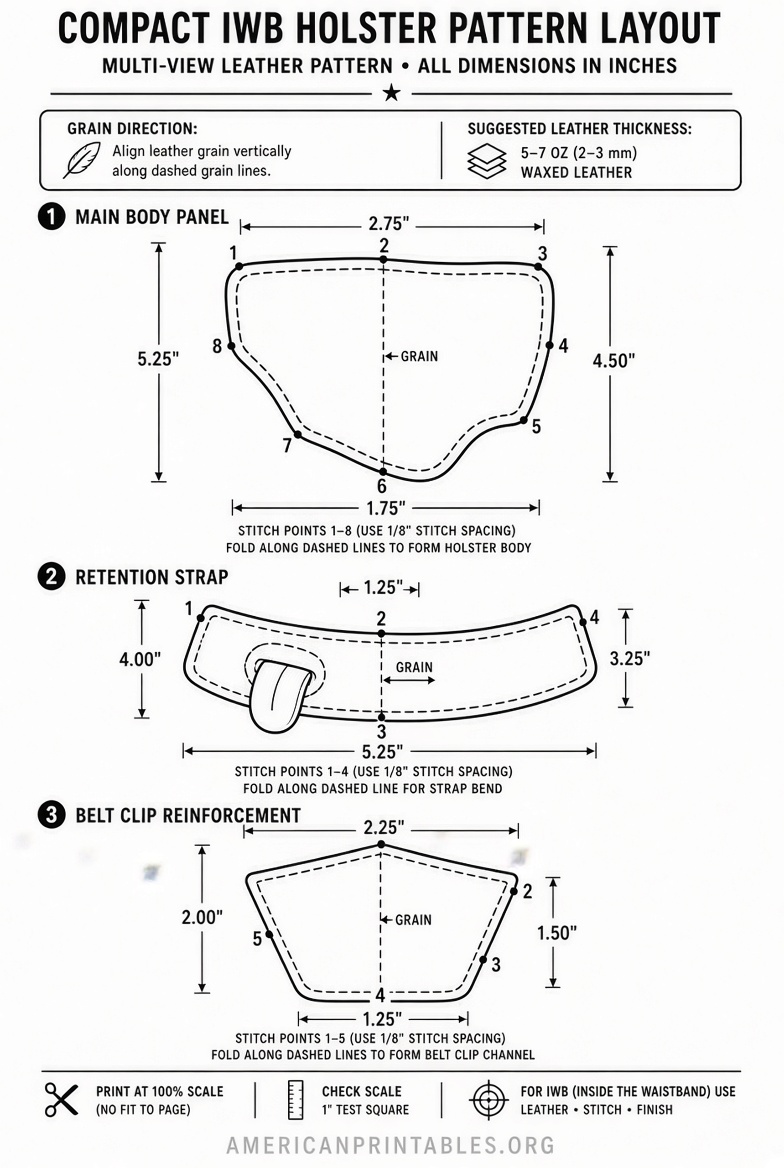
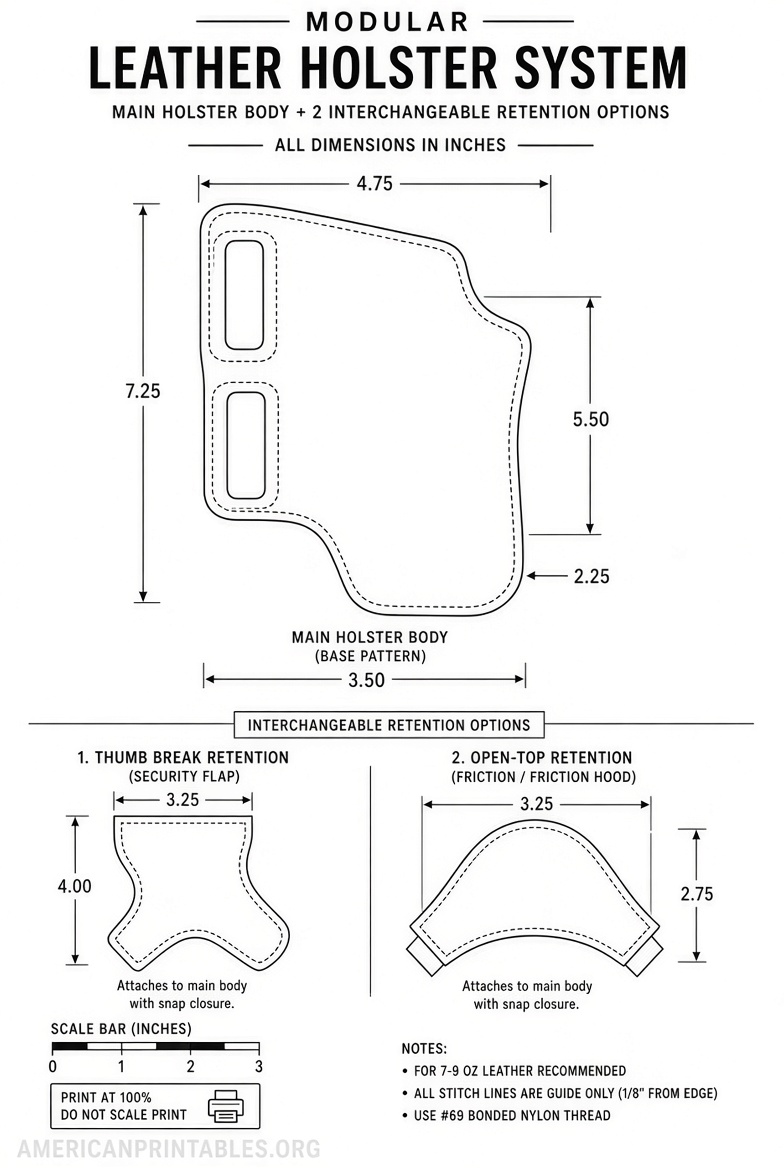
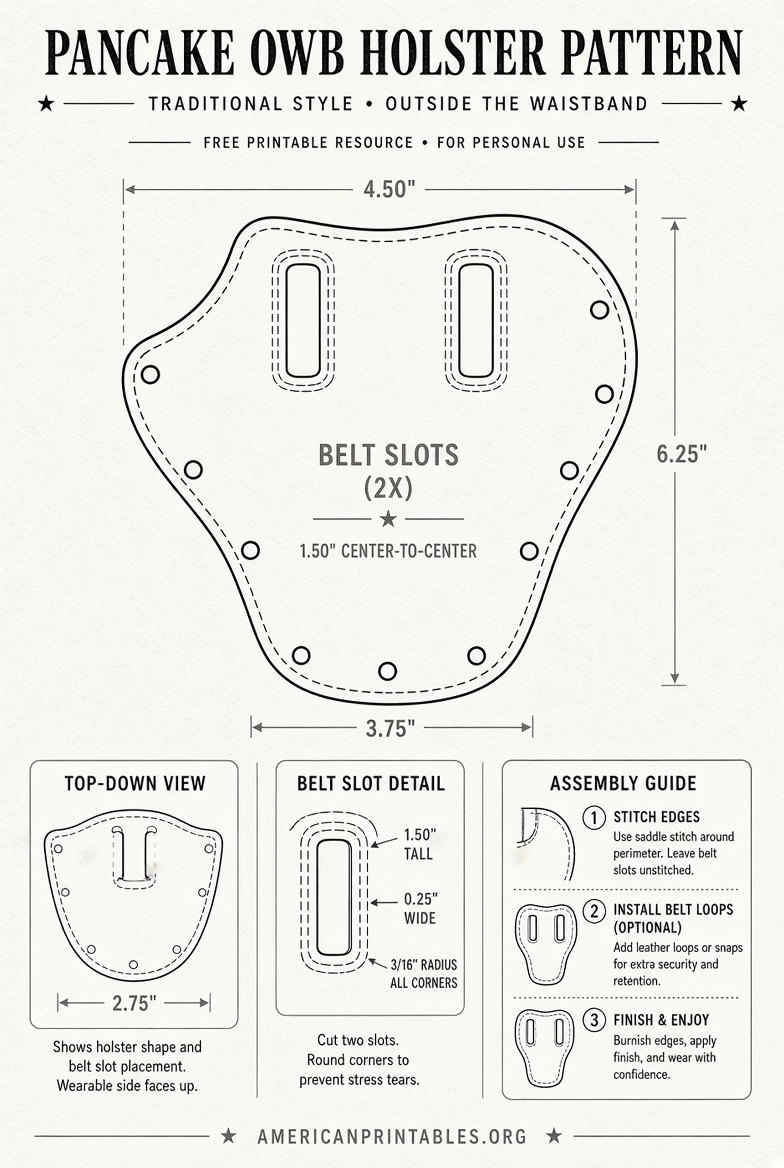
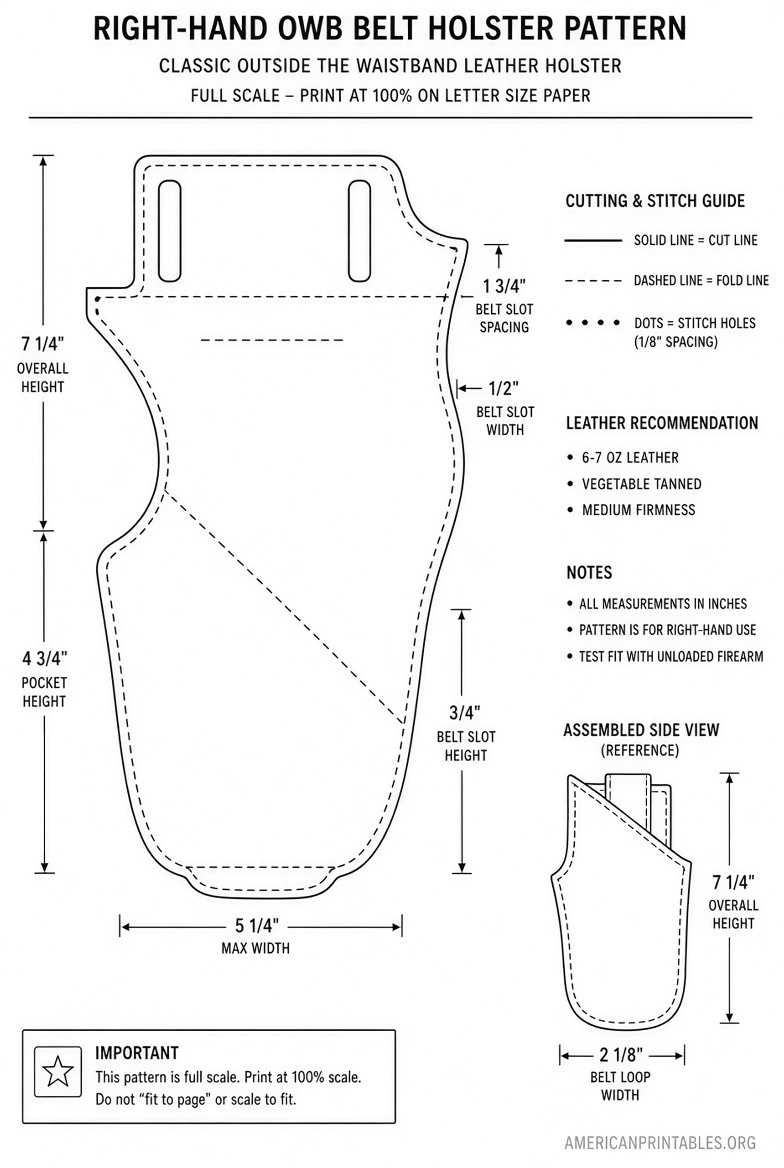
What a printable holster pattern includes?
A useful leather holster template PDF usually has:
- Full-size cutting outlines for each leather piece
- Stitch lines or marked punch holes
- Belt-slot placement for a 1.5″ or 1.75″ U.S. gun belt
- A 1″ or 2″ test square so you can confirm print scale
- Notes on leather weight (often 7–9 oz vegetable-tanned leather for a rigid holster)
Some files also include SVG or DXF versions for a laser cutter. A home printer and cardstock are enough if you plan to cut by hand.
One pattern almost never fits every gun. A Glock 19, a 1911, and a small-frame revolver need different outlines, sight channels, and retention. Treat a free file as a starting point, then mock it up in paper or cheap scrap leather before you cut good hides.
How to print a holster pattern at the correct size?
Use U.S. Letter paper (8.5″ × 11″) unless the file is marked for tabloid (11″ × 17″).
- Open the PDF in Adobe Acrobat or another reliable reader.
- In print settings, choose Actual Size or 100%. Do not use “Fit to page.”
- Print the page with the test square first. Measure it with a ruler.
- If the square is short, turn off page scaling and try again.
- For oversized patterns, print as a poster/tile, then tape the sheets together on the crop marks.
- Glue or tape the paper pattern to cardstock or a file folder so it survives tracing.
If the file is larger than Letter, a local copy shop can print it on tabloid paper. Ask them to set page scaling to none.
Legitimate places to get free printable holster patterns
These are the most useful free sources that were current at the time of writing. Always download from the official page, not a random file-host copy.
1. Springfield Leather Co. — free back-carry holster pattern
Springfield Leather Co. is a U.S. leather supplier. Its free-pattern library includes a Back Holster project with a direct PDF.
Open the project page and use the free pattern link:
Springfield Leather Co. Back Holster Free Pattern
The same library lists other free leather templates, including a shepherd’s sheath if you want a related carry project first:
Springfield Leather Co. Free Patterns
Note: the original demo video on the back-holster page has been removed. The PDF is still posted. Confirm the outline against your own firearm or a dummy gun before cutting leather. A comment on the page also asked which specific pistol the pattern was built around, so treat it as a workshop template, not a guaranteed fit for every model.
2. Instructables — free pistol holster files (PDF, SVG, AI)
This popular tutorial includes downloadable pattern files for a leather pistol holster originally designed around a Glock 17. The author notes it can work for similarly sized 9mm and .40 S&W Glocks, 1911s, and Beretta 92-size pistols, with adjustments for larger frames.
Download the files from the project page:
Make a Laser-Cut Leather Holster for Your Pistol (Instructables)
You do not need a laser. Print the PDF, cut by hand, then glue, stitch, and wet-form. The pattern is for a right-handed holster; flip it horizontally for a left-hand draw. Use heavy vegetable-tanned leather (about 8 oz or more) if you want a holster that holds its shape.
3. Instructables — design your own holster from the firearm
If no free file matches your gun, this tutorial walks through laying out a belt-slide and pocket holster on paper by tracing the firearm and adding thickness, stitch allowance, and belt loops.
Read the method here:
How to Design and Build a Leather Holster (Instructables)
This is often more useful than a mismatched “universal” PDF. Make the first version in paper, then in cheap leather.
4. Leatherworker.net — shared holster tutorials and PDFs
Leatherworker.net is a long-running U.S. leathercraft forum. Members have posted full tutorials and printable patterns, including a California Slim Jim holster lesson with pattern and instruction PDFs.
Start with this shared tutorial:
California Slim Jim Holster Tutorial and Patterns
The site’s holster section also has historical and custom patterns (Civil War, Dragoon, pancake, and others). Files are community-shared, so print at 100%, test the scale, and check comments for fit notes. Some older patterns are on 11″ × 17″ sheets.
Free Printable Leather Holster Patterns | USA Guide
Materials and tools most U.S. makers use
For a stiff belt holster:
- Leather: 7–9 oz vegetable-tanned cowhide. Chrome-tan is usually too soft for a formed holster.
- Thread: Waxed polyester or nylon, size 277 or similar.
- Needles and irons: Harness needles and 5 mm or 1/4″ stitching irons.
- Hardware: Chicago screws, snaps, or a thumb-break if the pattern calls for them.
- Forming: Water or a holster-forming solution, plus a dummy gun (Blue Gun or similar). Do not rely on an unloaded live firearm if you can avoid it.
- Finish: Fiebing’s or similar dye, then a resolene or wax topcoat.
A first holster is easier if you skip heavy Sheridan carving and focus on a clean pancake or fold-over shape.
Safety and fit notes for homemade holsters
A printable pattern is a craft template. It is not a guarantee of retention, coverage, or legal carry.
- Cover the trigger guard completely.
- The gun should not fall out when you turn the holster upside down and give it a firm shake.
- Wet-form around a dummy gun, then let the leather dry fully before daily use.
- A holster that collapses, covers the sight poorly, or lets the trigger stay exposed is not finished.
- Firearm carry rules differ by state. A homemade holster does not change licensing, location, or brandishing laws.
If you need a duty or concealed-carry holster for regular use, many makers start with a free pattern to learn the process, then move to a fitted commercial holster or a paid model-specific pattern.
When a free pattern is not enough?
Most exact-fit patterns for popular U.S. pistols (Glock 19, Sig P365, 1911, S&W Shield, and similar) are sold as inexpensive PDFs on maker sites and Etsy. Tandy Leather and Springfield Leather also sell official paper pattern packs and holster kits. Those are not free, and this page does not treat them as free downloads.
Use a free file to learn printing, tracing, stitching, and wet-forming. Buy a model-specific pattern when you need a precise sight channel, optic cut, or light-bearing pouch.
Quick project path for beginners
- Download one free PDF from Springfield or Instructables.
- Print at 100% on Letter paper and check the test square.
- Cut the paper pattern and wrap it around a dummy gun or similar-sized object.
- Transfer the outline to scrap veg-tan.
- Cut, glue the seam, stitch, then wet-form.
- Dye and finish only after the fit is acceptable.
If the first version is tight or loose, adjust the outline by 1/8″ at a time. Holster making is mostly pattern revision.
FAQ
Are free printable leather holster patterns actually full size?
They are meant to be, but only if you print at 100%. Always measure the test square.
Can one PDF fit every pistol?
No. Use a pattern made for your model, or draft your own from the firearm as shown in the Instructables design guide.
What paper should I use?
U.S. Letter for most home files. Print once on copy paper, then mount the keeper copy on cardstock.
Is a phone, tool, or bottle holster the same as a gun holster?
The leather skills are similar. The outline, retention, and safety requirements are not. Do not stretch a bottle or phone pattern into a firearm holster.
Where should I avoid downloading?
Skip scraped Scribd copies, calendar-template sites, and pages that promise “100 free holster designs” with no maker name. Prefer a U.S. supplier page, Instructables project files, or a known leathercraft forum.
A good free pattern saves leather and time. Print it at true scale, test the fit in paper, and treat the first leather version as a prototype. That is the fastest way to turn a free printable leather holster pattern into a holster that actually works.