Free Printable Autism Visual Cue Cards (USA) – Visual cue cards are small picture-and-word prompts that help autistic children and teens understand what is happening, what to do next, and how to communicate without relying only on spoken language. For many U.S. families, these free printable visual cue cards for autism are one of the fastest, lowest-cost supports to start at home, in the car, or in a classroom.
They are not a diagnosis tool and they do not replace speech therapy, an IEP, or a behavior plan. They are a practical visual support: a clear picture paired with a short phrase that reduces guesswork during routines, transitions, and moments of stress.
What Visual Cue Cards Are?
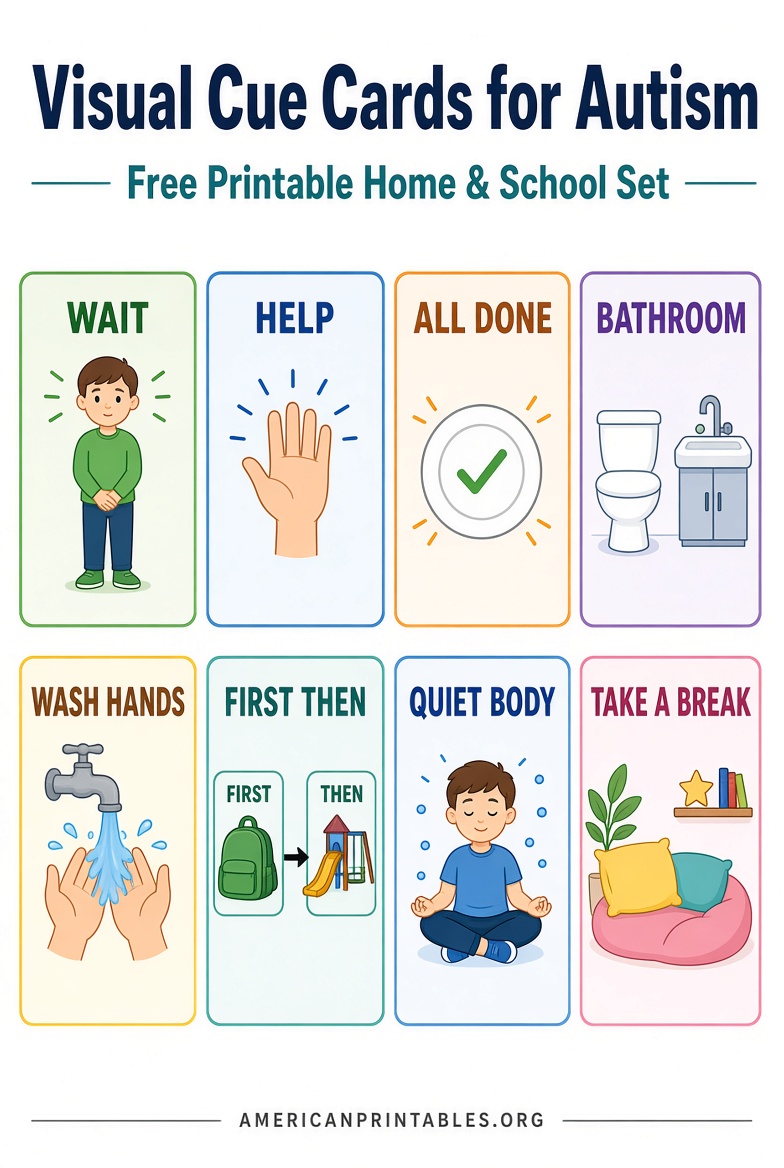
A visual cue card usually shows one idea at a time. Common examples include:
- “Wait”
- “All done”
- “First work, then break”
- “Bathroom”
- “Help”
- “Quiet body”
- “Take a breath”
Some cards support communication. Others support behavior, self-care, or classroom routines. The same card can live on a lanyard, a key ring, a fridge, a desk, or a first-then board.
Many autistic learners process pictures more quickly than spoken directions. A card gives the message extra time to land. It also stays visible after the words have ended, which is useful when a child is overwhelmed, nonverbal, minimally verbal, or still building language.
Why These Cards Help at Home and School?
Parents and teachers in the United States often use printable autism visual supports for the same reasons:
- They make routines predictable.
- They reduce repeated verbal prompts.
- They help with transitions such as leaving the house, lining up, or ending screen time.
- They give a child a way to request help, a break, or a preferred item.
- They can travel from home to school so expectations stay consistent.
Visual supports are widely used in special education and autism classrooms. They work best when the pictures are simple, the wording is short, and the same cards are used the same way every day.
Types of Free Printable Visual Cue Cards
Look for cards that match the skill you want to support.
Communication cards. Core words such as yes, no, more, help, stop, and all done. These are useful for children who point, exchange a card, or are beginning to use AAC.
Routine and self-care cards. Brush teeth, wash hands, get dressed, use the toilet, pack a backpack, and other daily living steps.
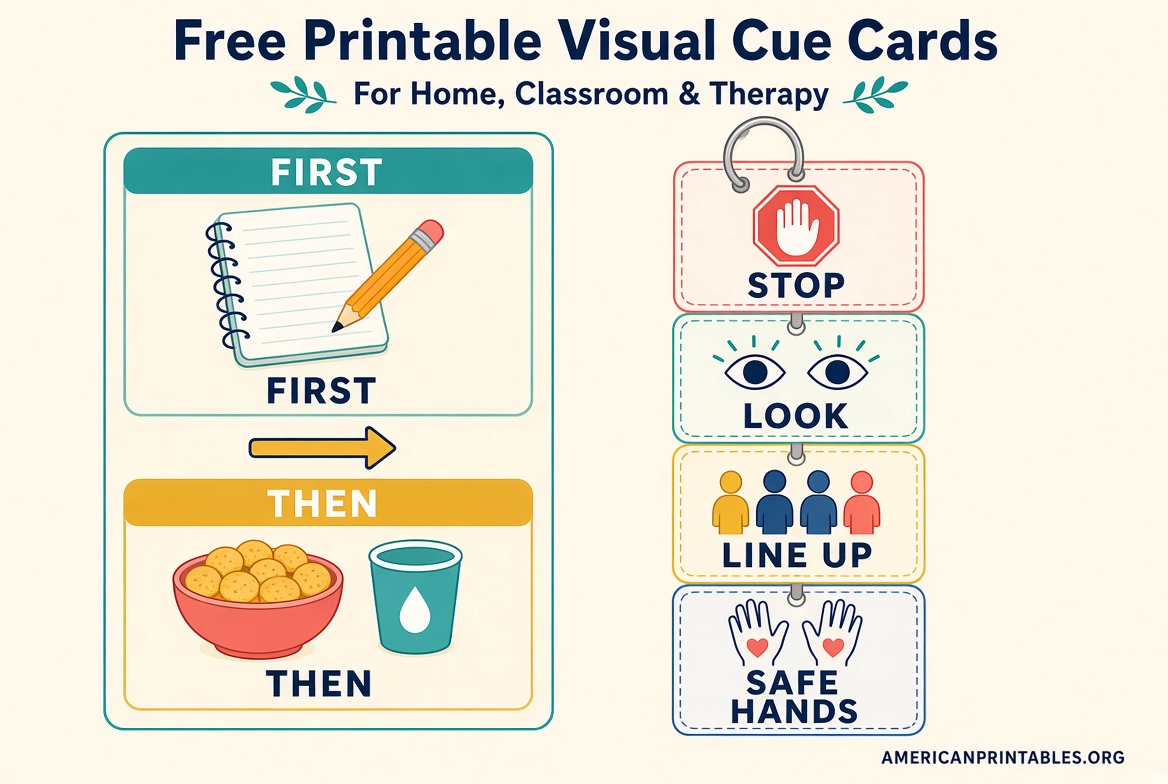
First-then and schedule cards. First a less-preferred task, then a preferred activity. These are a common starting point before a full visual schedule.
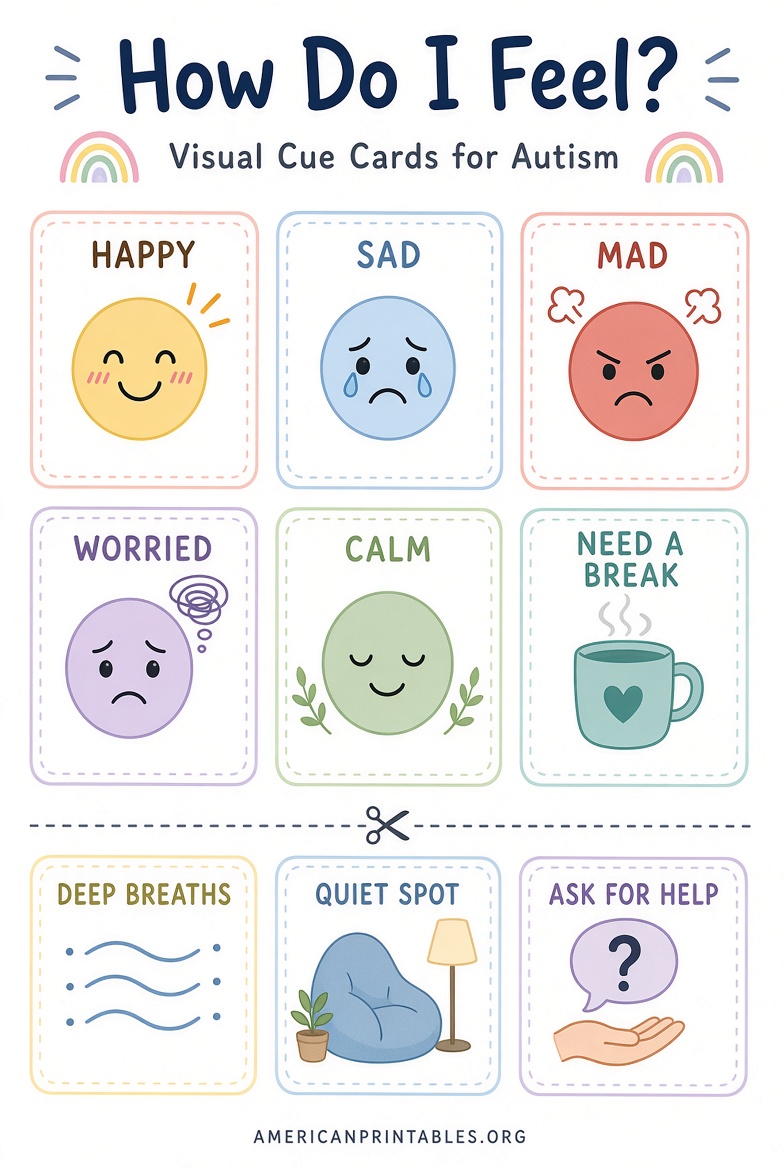
Feelings and regulation cards. Happy, sad, mad, scared, need a break, quiet spot, deep breaths.
Behavior and classroom cue cards. Wait, sit, line up, safe hands, inside voice, look, and similar prompts used by teachers and paraprofessionals.
Start with 6 to 12 cards. A huge deck can be harder to use than a small set the child actually recognizes.
Where to Get Legitimate Free Printables?
The resources below are free to use for personal or educational purposes. Always download from the official page, review the terms, and print on standard U.S. letter paper (8.5 x 11 inches).
Autism Parent Guide free templates offer 27 printable cards and boards with no account and no watermark. The set includes first words, yes/no boards, feelings cards, calm-down cards, first-then boards, and home routines. You can personalize many templates with your child’s photos before printing.
Do2Learn printable picture cards are a long-running U.S. special education resource. The Daily Living Skills section includes free toileting, hygiene, clothing, food, school, everyday activity, and safety cards. Many pages offer 1-inch and 2-inch sizes, with or without words, so you can build a lanyard set or a visual schedule.
Social Workers Toolbox communication cards include a free 96-card PDF for school and everyday settings. The cards cover feelings, sensory needs, asking for help, transitions, safety, and boundaries. They are designed for neurodivergent children, including autistic students.
Texas SPED Support behavior cue cards are official public-education visuals. The toolkit also includes related classroom supports such as wait cards and first-then cards. These are useful if you want simple school-style prompts that teachers already recognize.
Autism Speaks Visual Supports toolkit explains how visual supports work and includes printable examples such as first-then boards and visual schedules. The full toolkit may ask you to complete a short form. It is a good starting guide if you want both the “why” and sample printables from a well-known U.S. autism organization.
Avoid random Pinterest files with no source, paid listings marked as free only after an account upsell, or sites that claim a card set is free when it is actually a sample of a paid bundle. If a page requires payment after “free download,” it is not a free printable.
Free Printable Autism Visual Cue Cards (USA)
How to Print and Prepare the Cards?
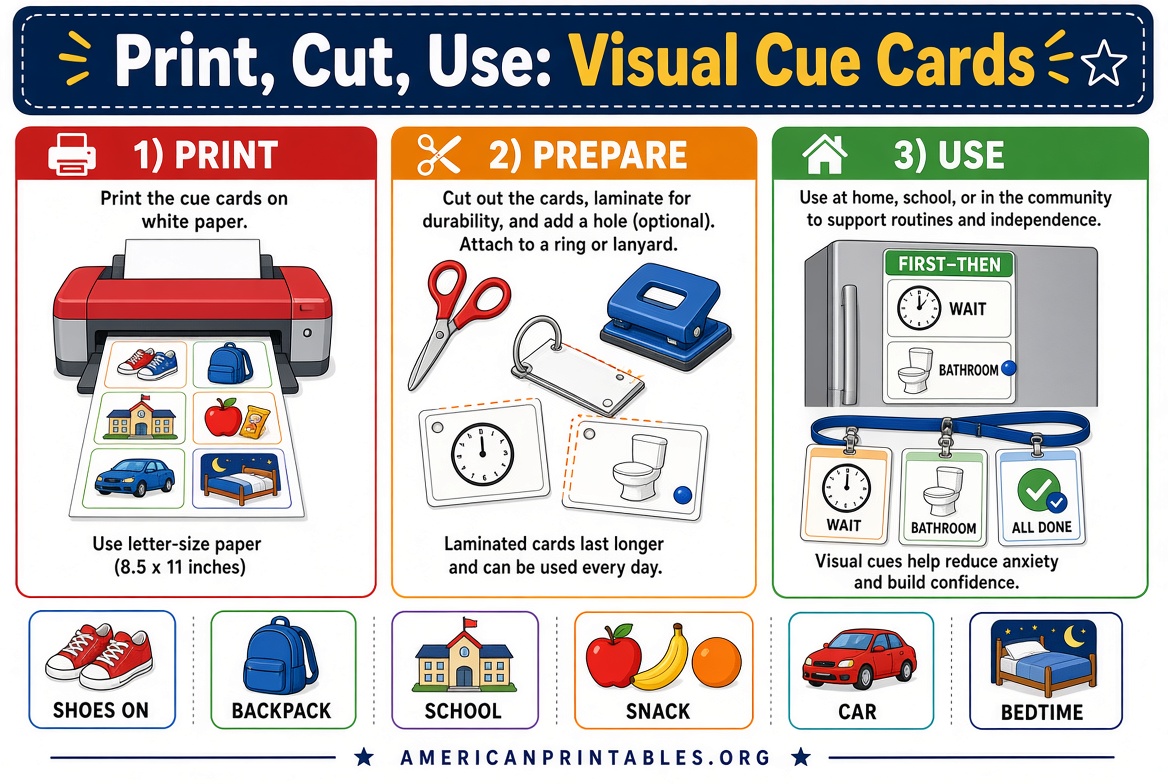
You do not need special software. A home printer and scissors are enough.
- Print in color when possible. High contrast helps many learners.
- Use cardstock if you have it. Regular paper works if you laminate.
- Cut the cards so each picture is easy to hold or point to.
- Laminate or cover with clear packing tape so the cards survive backpacks and sinks.
- Add Velcro dots if you want a first-then board or schedule strip.
- Punch a hole and place a few key cards on a binder ring or lanyard.
Keep a home set and a school set when you can. If a card works at breakfast, the same picture should appear at school whenever possible.
How to Introduce Cue Cards Without Overload?
Show the card while the action is happening. Do not wait until a meltdown to pull out a new picture.
- Hold the card at the child’s eye level.
- Say one short phrase that matches the picture: “Wait.”
- Give the child time to look.
- Pair the card with the real activity several times.
- Praise or acknowledge when the child uses or follows the card.
- Fade extra talking once the picture is familiar.
If a child does not understand clip art, switch to real photos of your bathroom, backpack, or calm-down spot. Personalized pictures often work better than generic icons.
Practical Card Sets for U.S. Families
A starter home set might include: bathroom, wash hands, eat, all done, wait, help, shoes on, and car.
A school or daycare set might include: sit, line up, quiet, work time, recess, lunch, break, and all done.
A community set for errands might include: store, wait, hold hands, almost done, and going home.
Put the most-used cards on a key ring that stays in your bag. Leave a duplicate set on the fridge or by the front door.
Tips for Working With Teachers and Therapists
If your child has an IEP or 504 plan in a U.S. public school, ask the team whether visual cue cards are already part of classroom supports. Many special educators use first-then boards, wait cards, and lanyard visuals.
Share a photo of the exact cards you use at home. Consistency matters more than having the prettiest design. A speech-language pathologist can also help you choose core vocabulary so the cards support communication, not only compliance.
Common Mistakes to Avoid
- Using too many cards at once.
- Changing the picture or wording every week.
- Showing a card after the child is already in crisis and expecting instant calm.
- Using busy backgrounds, fancy fonts, or crowded pages.
- Treating the card as a punishment instead of information.
A cue card is a support. It should tell the child what is expected or what they can request. It should not be used to shame a child for being overwhelmed.
FAQ
Are free printable visual cue cards the same as PECS?
Not always. PECS is a specific picture-exchange communication system with a teaching protocol. Many free cards look similar, but exchanging a picture to request is a skill that is usually taught with guidance from a speech therapist or trained team.
What age are these cards for?
They can help preschoolers, school-age children, and some teens or adults. Match the picture style and vocabulary to the person, not only the age on the download page.
Do I need to laminate them?
Lamination is not required, but it makes cards last longer in real homes and classrooms. Clear tape is a low-cost option.
Can I use these cards if my child is verbal?
Yes. Visuals can still support listening, transitions, and emotional regulation when spoken language is available but hard to use under stress.
Should I make my own cards?
Yes, if a free set does not match your child’s life. A phone photo of your toilet, bus, or bedtime book is often clearer than a generic icon.
Free printable visual cue cards for autism work best when they are simple, familiar, and used the same way across home and school. Start with a small set from a trusted source, practice during calm moments, and keep the cards where your child can see them when the next step is hard to understand.