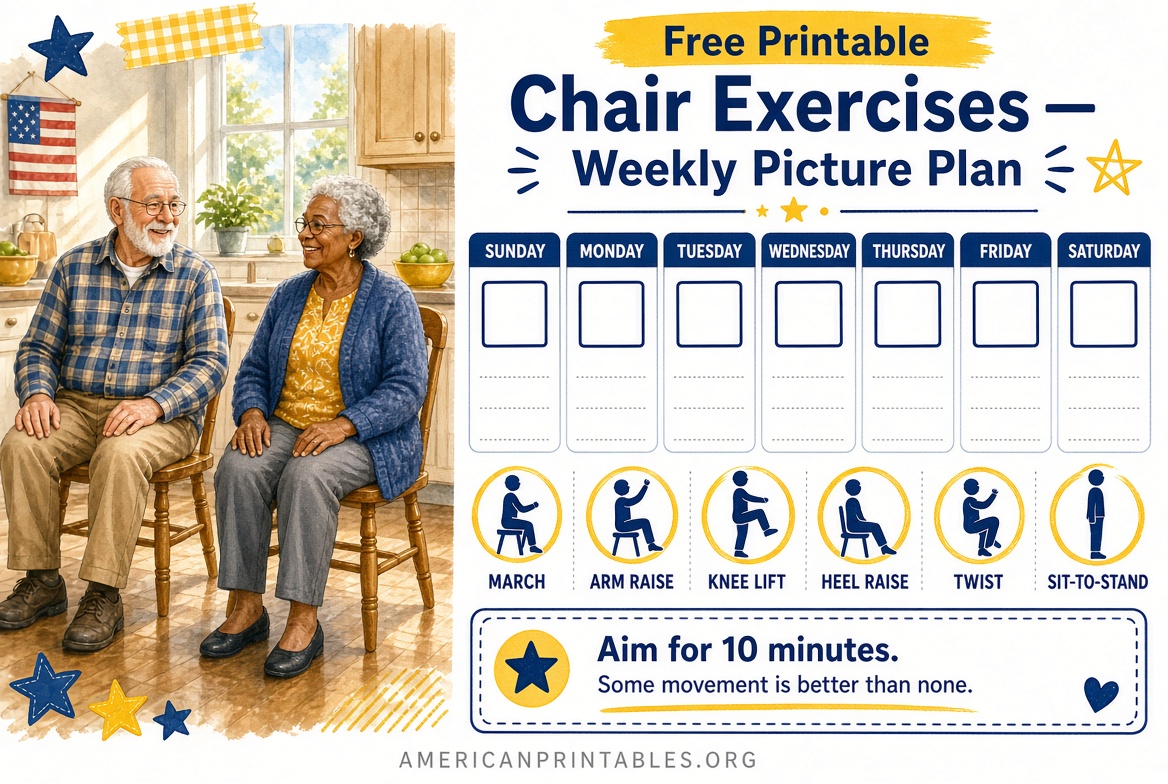
Free Printable Chair Exercises for Seniors With Pictures – Looking for free printable chair exercises for seniors with pictures? A one-page chart you can tape to the fridge is often easier to follow than a video. You sit in a sturdy chair, glance at the drawings, and move at your own pace.
This page explains what seated workouts do, how to use them safely at home in the United States, and where to download legitimate free printables. Every link below goes to a real resource. None of them require payment for the materials listed here.
What Are Chair Exercises for Seniors?
Chair exercises are seated or chair-supported moves that build strength, flexibility, circulation, and balance without getting down on the floor.
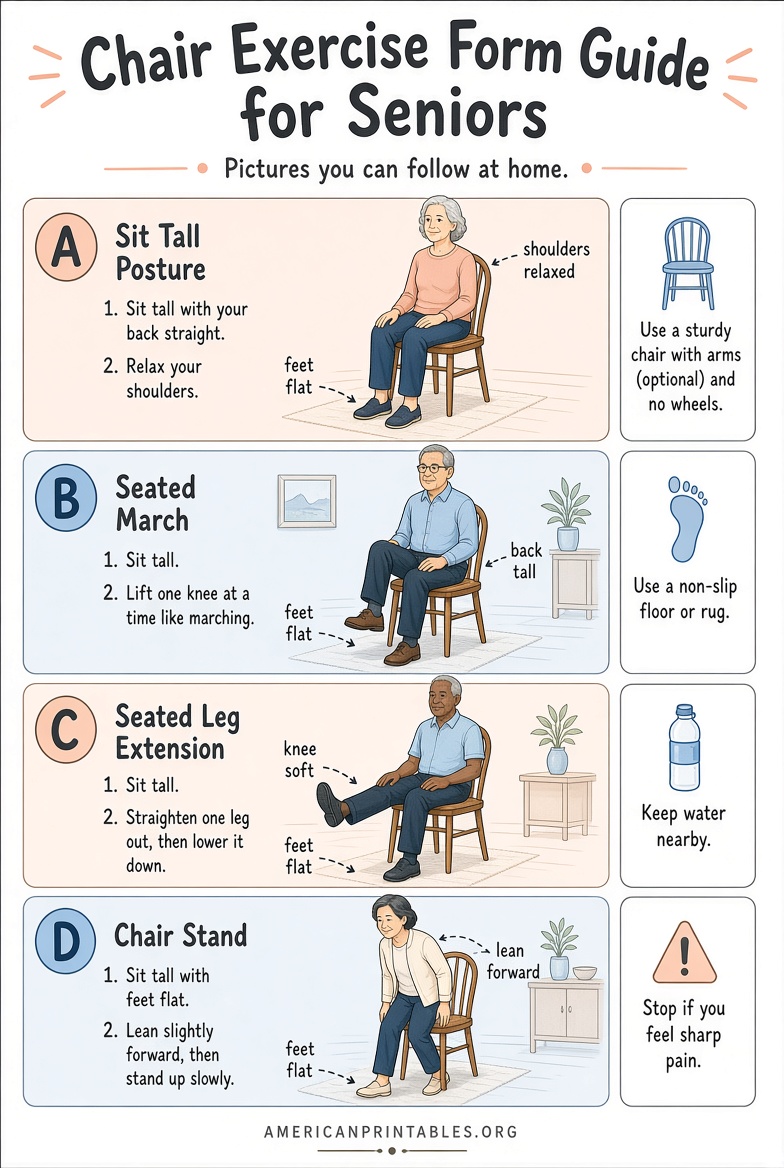
Most routines use a firm dining or kitchen chair that does not roll. Feet stay flat on the floor. You stay seated for most moves. A few charts add a careful sit-to-stand when that feels safe.
They are a good fit if you:
- Have limited mobility or balance concerns
- Are recovering from illness or inactivity
- Want a short daily routine you can do while watching TV
- Prefer paper instructions with pictures instead of an app
Why Seated Workouts Help Older Adults
The Centers for Disease Control and Prevention (CDC) recommends that adults 65 and older get at least 150 minutes a week of moderate aerobic activity, muscle-strengthening work on 2 or more days, and activities that improve balance.
Chair workouts will not replace a long walk by themselves. They can help you meet the strength and balance parts of that mix, especially if standing exercise is hard. Research on chair-based programs in older adults has found improvements in upper- and lower-body function.
Common benefits people notice with regular practice include:
- Easier sit-to-stand and stair use
- Less morning stiffness in the neck, shoulders, and hips
- Better ankle and foot mobility for walking
- A simple way to stay active on low-energy days
Talk with your doctor before you start if you have heart disease, uncontrolled blood pressure, recent surgery, dizziness, or joint replacements.
How to Use a Printable Chair Exercise Chart?
- Choose a sturdy chair with a flat seat. Place it on a non-slip floor, not a throw rug.
- Wear stable shoes or go barefoot if that is safer for you.
- Print the chart at 100% scale. Large type is easier to read from a few feet away.
- Warm up for 2 to 3 minutes with slow seated marching and shoulder rolls.
- Move slowly. Breathe out on effort. Never hold your breath.
- Stop any move that causes sharp pain, chest pressure, or dizziness.
- Start with one easy set. Add a second set only when the first set feels controlled.
Keep water nearby. Ten to 15 minutes most days is a realistic starting point.
Best Free Printable Chair Exercises With Pictures
These are the most useful free options we verified. You do not need to buy a “complete pack” to get a usable chart.
1. One-page illustrated chair chart (easiest to print)
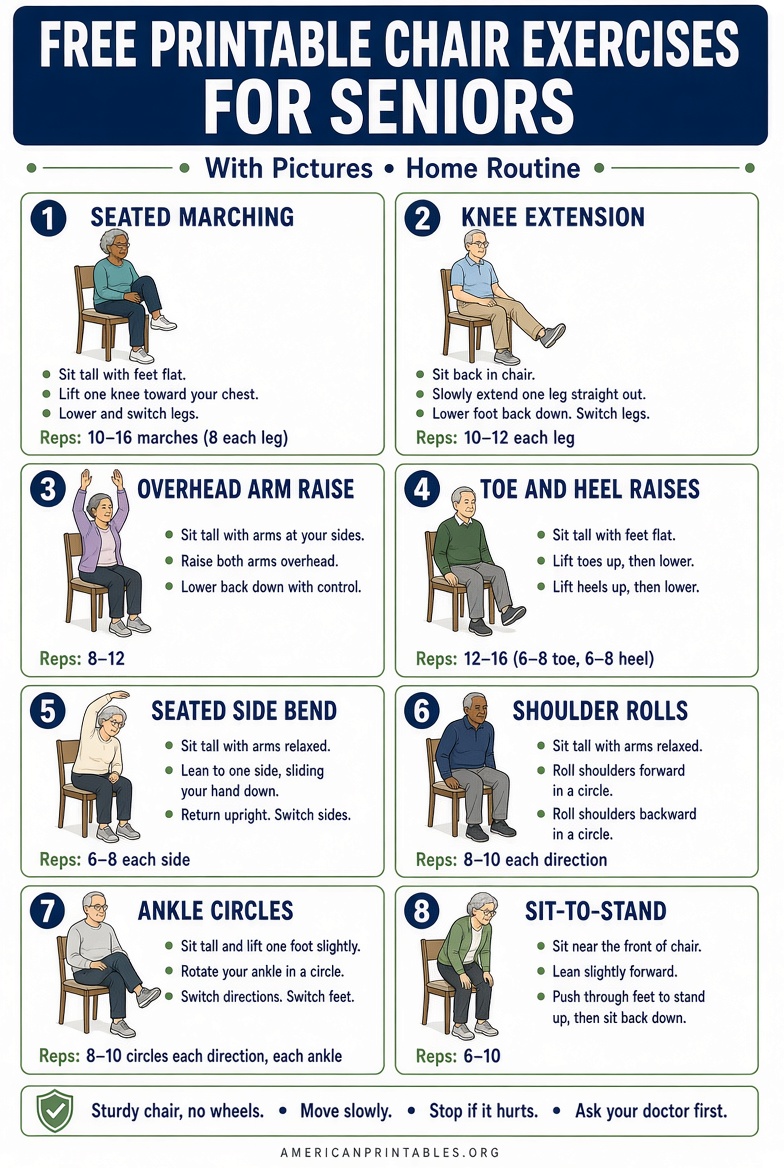
SeniorFit’s free chair exercise chart is a large-type printable with simple figures. No signup is required.
The chart includes 8 seated moves such as marching, knee extensions, arm raises, toe and heel raises, trunk twists, shoulder rolls, ankle circles, and a sit-to-stand. You can download the PDF from that page and keep it by your chair.
2. University of Georgia illustrated chair manual
Chair Exercises for Older Adults (University of Georgia PDF) is a free 34-page illustrated manual. The exercises were adapted from National Institute on Aging, Tufts University, and CDC sources.
It is longer than a fridge chart. That makes it useful for caregivers, senior centers, and anyone who wants progressions and modifications, not just one short routine.
3. Official U.S. strength guide with photos
If you want a government-backed booklet rather than a one-page poster, download Growing Stronger: Strength Training for Older Adults from CDC stacks. It is a free Tufts/CDC program with photographed exercises, several of which use a chair for support.
Use this when you are ready to add light strengthening beyond a basic seated warm-up.
Official Guidance From NIA and CDC
Printables are most useful when they match national recommendations.
The National Institute on Aging exercise and physical activity pages explain endurance, strength, balance, and flexibility in plain language. NIA also publishes free brochures and a 15-minute older-adult workout video that uses a sturdy chair.
The CDC physical activity guidelines for older adults are the U.S. benchmark: 150 minutes of moderate activity a week, 2 days of muscle strengthening, plus balance work. If you cannot meet that target yet, the CDC still advises doing what you can. Some activity is better than none.
Free Printable Chair Exercises for Seniors With Pictures
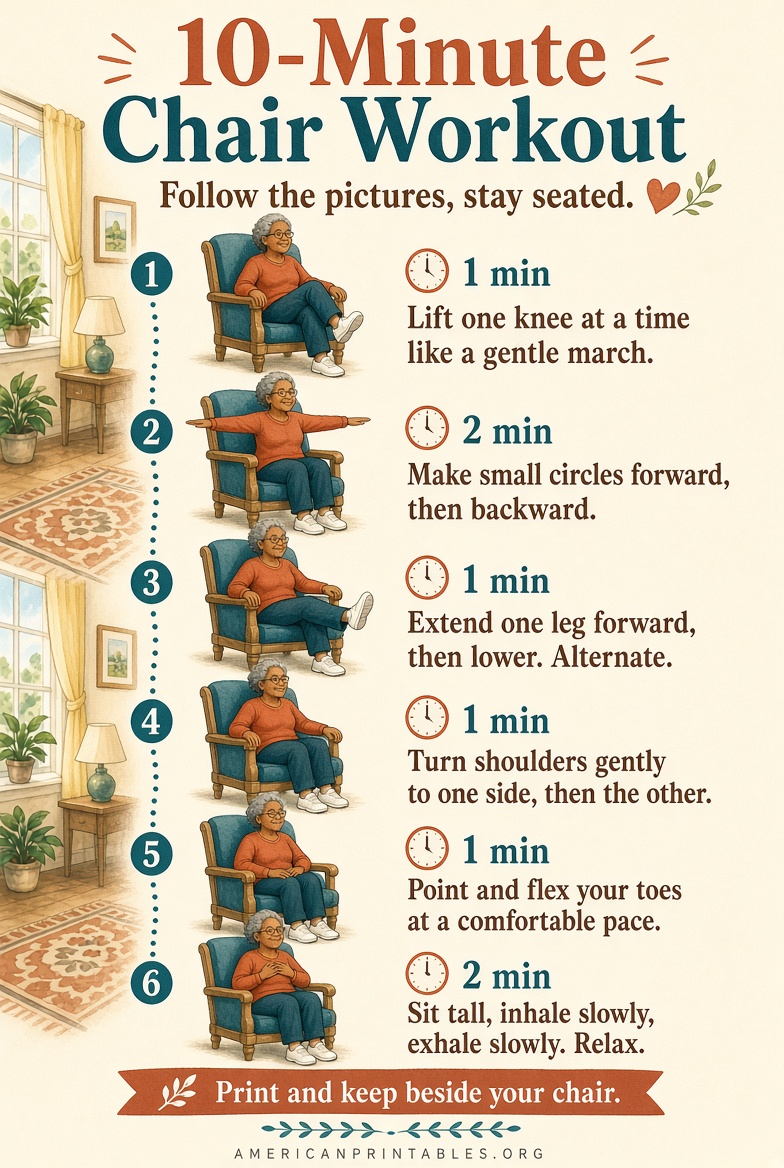
A Simple 10-Minute Seated Routine
Use this as a backup if your printer is not ready. Sit tall, feet flat.
Warm-up (2 minutes)
Seated marching, 20 easy lifts. Shoulder rolls, 8 backward and 8 forward.
Strength (5 minutes)
Seated knee extension: straighten one leg, hold 2 seconds, lower. 8 reps each leg.
Seated arm raises: lift both arms forward, then lower. 10 reps.
Toe raises, then heel raises. 10 of each.
Mobility (2 minutes)
Ankle circles, 8 each direction on each foot. Gentle seated trunk turns, 6 each side.
Finish (1 minute)
Sit-to-stand only if you feel steady. Hold the chair if needed. 5 slow stands. Then sit and breathe.
That sequence matches the moves found on most senior chair charts. It is not a substitute for personalized physical therapy.
What to Look For in a Good Senior Exercise Printable?
Skip cluttered pages and anything that hides the download behind a paid upsell.
A useful chart usually has:
- Clear line drawings or photos of each move
- Large print you can read without leaning in
- Reps and sets written next to the picture
- A reminder to check with a doctor
- A sturdy-chair note (no wheels)
Be cautious with sites that call a one-page sheet “free” and then push a $10 card deck before the PDF opens. The three downloads above work without a purchase.
Frequently Asked Questions
Are free printable chair exercises for seniors with pictures safe?
They are generally low impact, but “gentle” is not the same as risk-free. Get medical clearance if you have chest pain, dizziness, osteoporosis with fracture risk, or a recent joint replacement.
How often should I do seated exercises?
Most beginners do well with 10 to 15 minutes, 3 to 5 days a week. Strength moves should not hammer the same muscles two days in a row.
Do I need weights?
No. Body weight is enough at first. Soup cans or light dumbbells can come later if your clinician agrees.
Is chair yoga the same thing?
Chair yoga uses similar seated positions with more stretching and breathing. Many seniors use both: a strength chart on weekdays and a short chair-yoga page on rest days.
Can these exercises prevent falls?
Balance and leg strength help reduce fall risk, which is why CDC programs include chair-rise practice. A printable chart is a starting tool, not a complete fall-prevention plan.
Bottom Line
The fastest way to start is to print one illustrated page, set a chair against a wall, and do a short routine most days. Begin with the free SeniorFit chair chart if you want pictures on a single sheet. Use the University of Georgia manual or CDC’s Growing Stronger guide when you want more detail.
Pair that printable with NIA and CDC advice, keep the moves slow, and ask your doctor or a physical therapist to review the sheet if you have a health condition. Consistency matters more than a perfect workout.