Free Printable EKG Interpretation Cheat Sheet (2026) – An EKG (also called an ECG) records the heart’s electrical activity on paper. For nursing students, paramedics, new RNs, PAs, NPs, and anyone preparing for ACLS or NCLEX in the United States, a free printable EKG interpretation cheat sheet is a practical study aid you can keep in a binder, clip to a badge reel, or tape inside a notebook.
This page explains how to read a strip in a consistent order, lists the values most U.S. programs expect you to memorize, and points you to legitimate free printables and official teaching sites. A cheat sheet is a memory tool. It is not a substitute for current American Heart Association (AHA) guidelines, your facility protocol, or a licensed clinician’s judgment.
What an EKG interpretation cheat sheet should include?
A useful sheet is short enough to print on letter-size paper and complete enough to use at the bedside or during a practice quiz. Look for:
- Paper speed and box values (time and voltage)
- Normal adult intervals
- A step-by-step reading method
- Common rhythms with one-line recognition cues
- Lethal rhythms called out separately (VT, VF, asystole, complete heart block)
- Space to write rate, regularity, P waves, PR, QRS, and QT
“EKG” is the spelling most U.S. nursing and EMS programs use. “ECG” is the same test. Good sheets use both so search and classroom language match.
How to read an EKG strip the same way every time?
Most errors come from skipping steps, not from missing a rare diagnosis. Use this order on every strip:
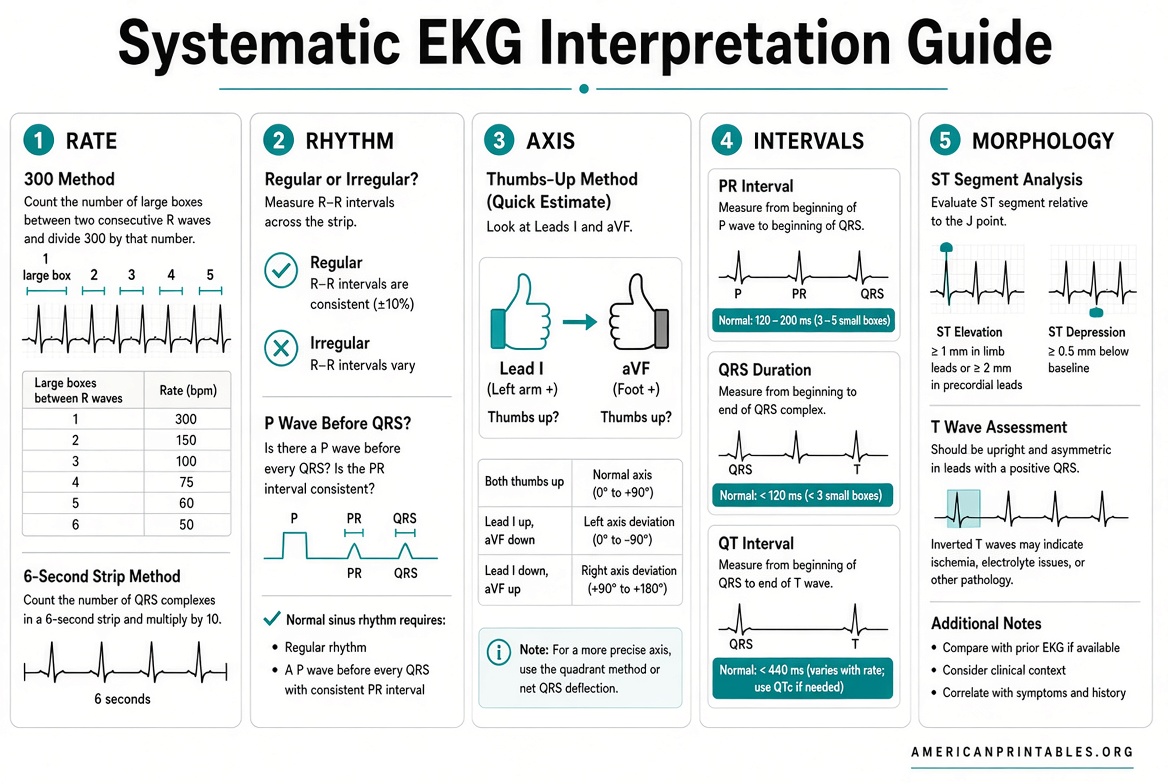
- Confirm the tracing is labeled, timed, and run at standard speed (25 mm/sec) and calibration (10 mm/mV).
- Rate: regular vs. irregular method.
- Regularity: march R-R (and P-P) intervals.
- P waves: present, upright in lead II, one before every QRS?
- PR interval: start of P to start of QRS.
- QRS width: narrow or wide.
- QT/QTc and ST-T changes.
- Compare the strip with the patient: pulse, blood pressure, symptoms, and oxygen.
If the patient is unstable, treat the patient first. Rhythm labels come second.
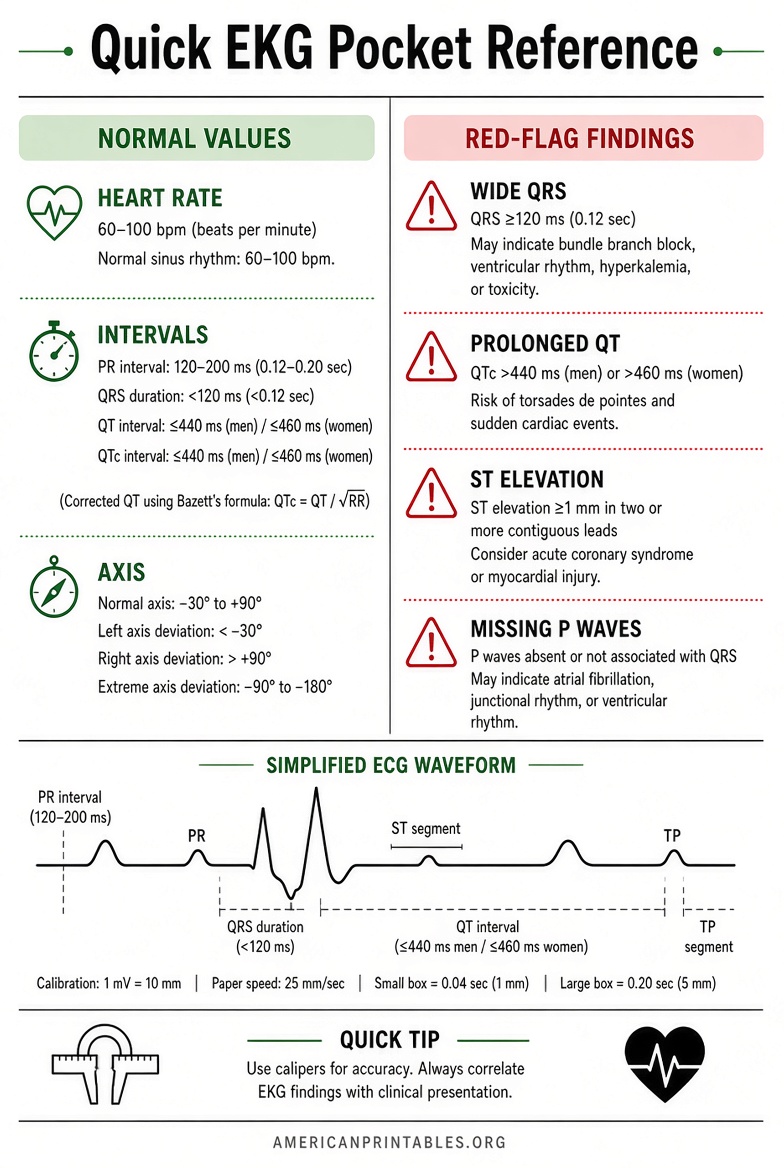
EKG paper values (U.S. standard)
| Measurement | Small box | Large box |
|---|---|---|
| Time | 0.04 sec | 0.20 sec |
| Voltage | 0.1 mV (1 mm) | 0.5 mV (5 mm) |
| 6-second strip | 30 large boxes | Count QRS complexes × 10 |
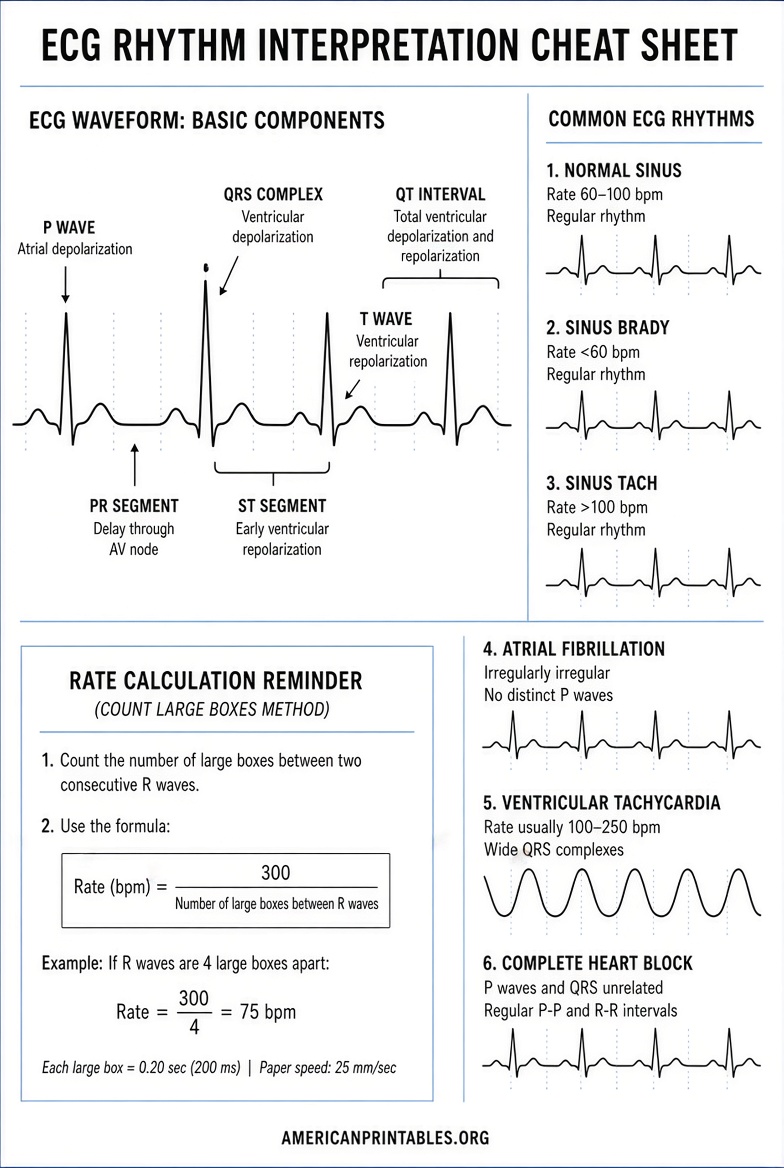
Rate shortcuts for a regular rhythm: 300 ÷ number of large boxes between two R waves. Memory sequence: 300, 150, 100, 75, 60, 50.
Rate for an irregular rhythm: Count QRS complexes on a 6-second strip and multiply by 10.
Normal adult reference values
These are the ranges taught in most U.S. nursing, paramedic, and ACLS review courses. Pediatric values differ.
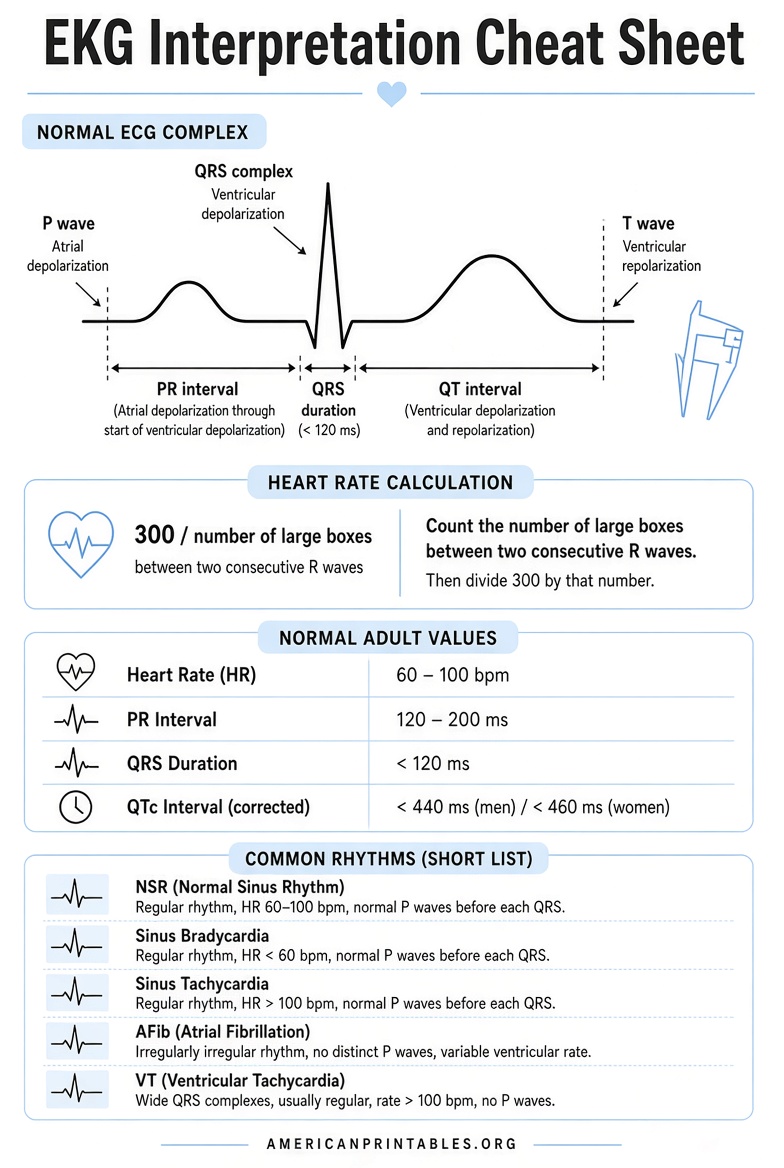
- Heart rate: 60–100 bpm
- P wave: 0.06–0.12 sec; upright in I, II, aVF
- PR interval: 0.12–0.20 sec (3–5 small boxes)
- QRS: less than 0.12 sec (many courses use <0.10–0.12 sec)
- QT: roughly less than half the R-R interval; always consider QTc and drugs/electrolytes
If a value is borderline, write the measurement. Do not force a label.
Common rhythms a cheat sheet should help you spot
Use pattern plus measurements. One feature is not a diagnosis.
Sinus rhythms
- Normal sinus: regular, 60–100, P before every QRS, normal PR and QRS
- Sinus tach: same morphology, rate >100
- Sinus brady: same morphology, rate <60
Atrial rhythms
- Atrial fibrillation: irregularly irregular, no consistent P waves
- Atrial flutter: sawtooth flutter waves, often 2:1, 3:1, or variable conduction
- PAC: early beat with an abnormal P wave, then a pause
Blocks
- First-degree AV block: PR >0.20 sec, every P conducted
- Mobitz I (Wenckebach): PR lengthens until a QRS drops
- Mobitz II: constant PR, sudden dropped QRS
- Third-degree (complete) heart block: P waves and QRS independent
Ventricular and arrest rhythms
- PVC: early wide QRS, usually a compensatory pause
- Ventricular tachycardia: wide, regular, usually 100–250, no normal P-QRS relationship
- Torsades de pointes: polymorphic VT that appears to twist around the baseline
- Ventricular fibrillation: chaotic, no QRS you can measure
- Asystole: flat line after you confirm leads, gain, and another lead
For ACLS, the shockable arrest rhythms are VF and pulseless VT. Asystole and PEA are not shocked.
Where to get a legitimate free printable EKG interpretation cheat sheet?
Many “free PDF” results lead to paid packs, email funnels, or low-quality scans. The sources below are established education sites. Open each in a new tab, then print or save.
1. Nurseslabs EKG interpretation cheat sheet (best first print)
Nurseslabs publishes a free, no-signup arrhythmia guide with printable image sheets covering sinus, atrial, junctional, ventricular, and AV-block rhythms, plus common causes and treatments. Click the Part 1–3 images, save them, and print on U.S. letter paper. The page was updated in 2024 and is written by a U.S. registered nurse.
Download the Nurseslabs free EKG interpretation cheat sheet
2. Free rhythm and 12-lead templates (actual PDFs)
ECG Course posts free letter-size PDFs: a lead-II rhythm reading template, a 12-lead “HEART” mnemonic template, and a sample workbook page. No account is required for those files. Use the templates as worksheets while you practice strips.
Get the free printable ECG rhythm and 12-lead templates
3. Life in the Fast Lane ECG Library (reference atlas)
LITFL is a widely used free ECG library for emergency and critical-care education. It is not one page of clip-art, but it is the site many U.S. residents and educators use to check criteria, examples, and differentials. You can print individual topic pages for study.
Open the LITFL free ECG Library
4. Practical Clinical Skills ECG training and reference
This U.S.-oriented site offers free ECG lessons, a reference guide covering dozens of abnormalities, and practice quizzes. It is useful after you print a one-page sheet and want more strips. Some advanced quizzes offer optional certificates; the core lessons and reference guide are free.
Practice free ECG strips and open the reference guide
5. University of Utah ECG Learning Center (academic course notes)
The Alan E. Lindsay ECG Learning Center, taught for decades at the University of Utah, is a free introduction to clinical electrocardiography with a recommended interpretation method, illustrations, quizzes, and downloadable work-assignment PDFs. It is a strong official-style resource for students who want more than a one-page chart.
Use the University of Utah free ECG Learning Center
Avoid random marketplace PDFs that claim “AHA official cheat sheet” unless you can trace them to the organization. AHA course materials are copyrighted and sold through authorized training centers.
Free Printable EKG Interpretation Cheat Sheet (2026)
How to print and use the sheet in school or clinicals?
- Print in color if the sheet uses color-coded leads or ST changes; otherwise black-and-white is fine.
- Use U.S. Letter (8.5 × 11 in). Scale to 100% so box sizes stay readable.
- Laminate a one-page version for clinical. Keep a full packet in your study binder.
- Cover the “answer” column and interpret a new strip daily.
- After each strip, say the eight-step method out loud. Speed comes from repetition, not from a prettier chart.
- Follow your school and hospital rules. Some units do not allow unofficial cards at the bedside.
Limits of any free printable EKG interpretation cheat sheet
- Criteria differ slightly by textbook (especially QRS cutoff and QTc formulas).
- A 3-lead or 5-lead monitor strip is not a 12-lead. Ischemia and bundle-branch block need a 12-lead.
- Artifact, lead reversal, tremor, and Parkinsonian movement can mimic VF or flutter.
- Treatment on older sheets may not match the latest AHA ACLS/PALS algorithms.
- Always treat the unstable patient first.
If you are recertifying ACLS, pair your printed sheet with your training center’s current provider manual and megacode practice.
Quick study plan (one week)
Day 1–2: Paper values, rate methods, normal sinus only.
Day 3: Tachycardias — sinus tach, AF, flutter, SVT.
Day 4: Bradycardias and AV blocks.
Day 5: Wide-complex rhythms and arrest rhythms.
Day 6: 20 mixed practice strips from a free quiz site.
Day 7: Timed review with only your printed cheat sheet.
That sequence matches how most U.S. nursing and paramedic labs introduce rhythm recognition.
FAQ
Is a free printable EKG interpretation cheat sheet enough to pass ACLS?
No. It helps you recognize the rhythms ACLS tests, but you still need the algorithms, pharmacology, and megacode practice from an authorized AHA course.
What paper size should I use in the USA?
U.S. Letter, 8.5 × 11 inches. Do not shrink the page so much that small boxes become unreadable.
Are EKG and ECG the same?
Yes. EKG comes from the German spelling. U.S. hospitals and NCLEX items use both.
Can I use a cheat sheet during a clinical shift?
Ask your instructor or preceptor. Many units allow a personal reference card; some testing environments do not.
Which lethal rhythms should be on the first page?
Ventricular fibrillation, pulseless ventricular tachycardia, asystole, and complete heart block. Put them where your eye hits first.
A good free printable EKG interpretation cheat sheet saves time only if you already have a method. Print one trusted sheet, practice real strips every day, and check difficult tracings against a full library—not against social-media infographics.