Free Printable Hand and Foot Rules | Card Game – Looking for free printable Hand and Foot rules you can keep at the table? Hand and Foot is a popular U.S. card game in the Canasta family. Most families play it with partners, several decks, and a score pad. There is no single official rulebook, so a printed cheat sheet plus a score sheet saves a lot of mid-game debate.
This page explains the game in plain language and points you to legitimate, currently available free printables. No invented downloads. Every link below goes to a real rules page, PDF, or score sheet.
What Is Hand and Foot?
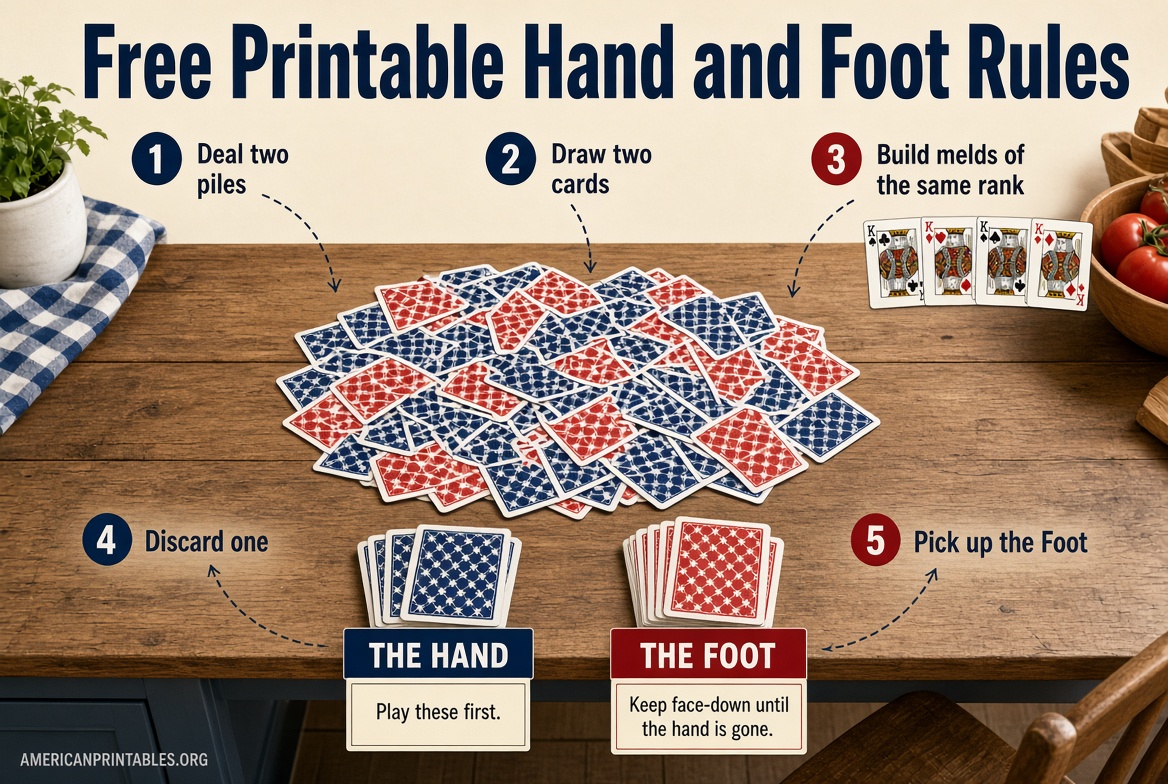
Hand and Foot is a rummy-style game. Each player gets two piles of cards:
- The hand, which you play first
- The foot, which stays face-down until the hand is gone
You score by making melds (sets of the same rank) and turning those melds into books of seven cards. A full game is usually four rounds. The team with the highest score after the last round wins.
It is most often played in the United States with four people, two teams of two, sitting across from each other. Two to six players can work if you agree on decks and deal size first.
Where to Get Free Printable Hand and Foot Rules?
Use these trusted sources if you want something you can print on standard U.S. Letter paper. Confirm the version matches the house rules at your table before you start.
1. Skip to My Lou — rules PDF and score sheet
This family-game page includes long-form instructions plus free printable rules and a matching score sheet. The version uses 11-card hands and feet, four rounds, and common U.S. meld minimums (50 / 90 / 120 / 150). Download from the article here: Skip to My Lou Hand and Foot card game printables.
2. Fields of Heather — rules, cheat sheets, and score sheets in one packet
A single free Google Drive file collects printable rules, player cheat sheets, and scoring pages. Useful if you want one packet for every seat at the table: Fields of Heather printable Hand & Foot packet.
3. Gather Together Games — free score sheet PDF
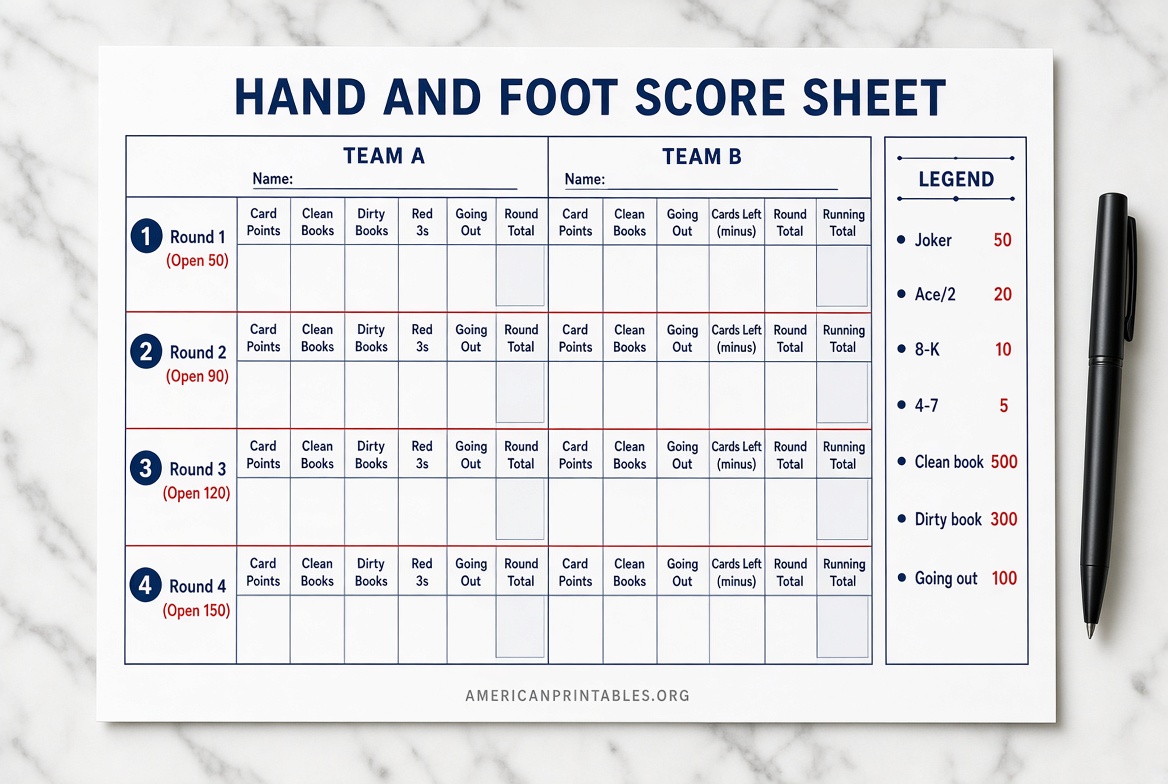
If you already know the rules and only need a clean scoresheet, this printer-friendly PDF has space for teams, card points, clean and dirty books, red threes, going-out bonuses, and running totals: Free Hand and Foot score sheet (PDF).
4. Pagat — the most complete written rules reference
Pagat is the standard independent encyclopedia of card-game rules. Its Hand and Foot page states clearly that there is no official standard, then explains a widely used partnership version plus common variants. Print the page or keep it open on a phone: Pagat Hand and Foot card game rules.
5. Official Game Rules — step-by-step how-to-play guide
A current, easy-to-scan walkthrough covering setup, turns, meld minimums, and scoring for U.S. players: How to play Hand and Foot.
Print one rules sheet and one score sheet per table. If your group already has house rules, write those on the score sheet so everyone is playing the same game.
Free Printable Hand and Foot Rules | Card Game
What You Need to Play?
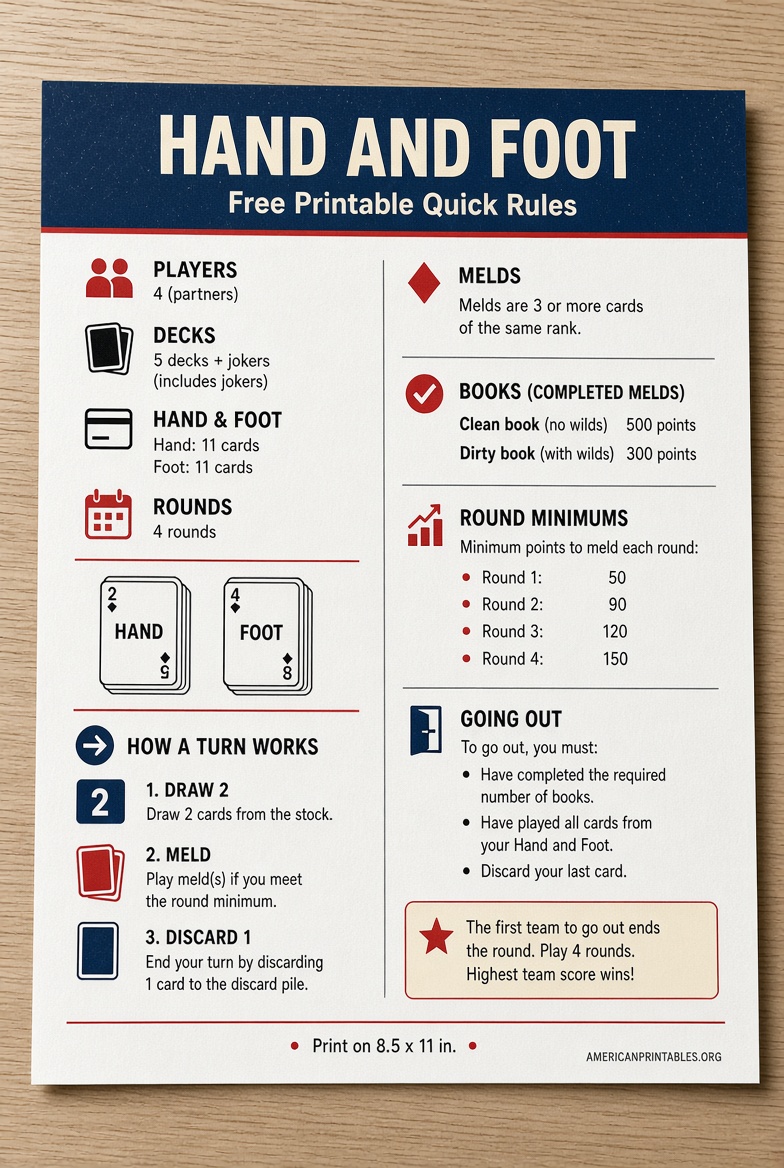
Most four-player U.S. tables use:
- 5 standard decks, including jokers (about 270 cards)
- A rule of thumb: one deck per player, plus one extra deck
- Partners sitting across from each other
- A printed score sheet and a pen
- Table space for shared team melds
Common deal sizes:
- 11-card hand and 11-card foot (very common)
- 13-card hand and 13-card foot (also common)
Agree on the deal size before the first shuffle. Mixing 11-card and 13-card rules in the same night is how arguments start.
How a Turn Works?
Play moves clockwise. On your turn:
- Draw two cards from the stock, or take the discard pile if your group’s rules allow it and you can use the top card right away.
- Lay down new melds or add cards to your team’s existing melds, if you can.
- Discard one card to end the turn.
You must empty your hand before you may pick up your foot. When the last card leaves the hand, pick up the foot immediately and keep playing that same turn if your house rules allow it.
Melds, Books, and Wild Cards
A meld is three or more cards of the same rank, such as four 9s.
- Jokers and 2s (deuces) are wild.
- A meld usually must contain more natural cards than wild cards.
- A completed pile of seven cards is a book (sometimes called a canasta).
- A clean (red) book has no wild cards.
- A dirty (black) book includes at least one wild card.
Threes are special in most versions. Black 3s are often used only as safe discards. Red 3s are usually laid down at once and scored separately. Check your printed sheet, because this is one of the biggest differences between house rules.
Four Rounds and Minimum Melds
A standard game is four rounds. Before a team can put cards on the table for the first time in a round, those cards must meet a point minimum:
| Round | Common minimum to open |
|---|---|
| 1 | 50 points |
| 2 | 90 points |
| 3 | 120 points |
| 4 | 150 points |
After a team has opened, later melds in that round do not need to hit the minimum again.
Some groups use 60 points in round one instead of 50. If you print a score sheet that lists 50/90/120/150, say so out loud before deal one.
Card Values Used for Scoring
These values are the ones you will see on most free printable Hand and Foot score sheets in the United States:
- Joker: 50
- Ace and 2 (wild): 20
- 8 through King: 10
- 4 through 7: 5
Books and bonuses are added after card points:
- Clean book: often 500
- Dirty book: often 300
- Going out: often 100 (some clubs use 300)
- Cards left in a hand or foot: subtract their point values
Red 3s and black 3s vary the most. One group may give +100 for a played red 3. Another may treat leftover red 3s as a steep penalty. Put the version you chose on the printed sheet.
Going Out
You cannot end a round just because your last card is gone. Most partnership games require some mix of completed books first. Common requirements include:
- At least one clean book and one dirty book, or
- Two clean books and two dirty books, and sometimes a wild book
Many tables also require that your partner has already picked up their foot, and that your partner gives permission to go out. If your printable lists a different “go out” contract, follow that sheet for the whole night.
Quick Setup Checklist
- Shuffle all decks together.
- Deal each player a hand pile and a foot pile of the agreed size.
- Leave the foot face-down.
- Turn one stock card to start the discard pile. If it is a red 3 or a wild, bury it and flip the next card.
- Player to the dealer’s left starts.
- After four rounds, add the scores. Highest total wins.
If a player cuts or draws exactly 22 cards on the first try, some versions award a 100-point bonus. Only use that bonus if it is on your printed rules.
House Rules You Should Settle First
Because there is no official Hand and Foot rulebook, decide these points before you deal:
- 11-card piles or 13-card piles
- How many decks
- Whether you take the whole discard pile or only the top card
- How many clean and dirty books you need to go out
- How red 3s score
- Whether a partner must approve going out
Write the answers in the margin of your free printable rules. That single note prevents most table arguments.
FAQ
Is there one official set of Hand and Foot rules?
No. Pagat and most U.S. teaching sites say the game has many local versions. Print one packet and play that version all night.
Can I print the rules for free?
Yes. The Skip to My Lou PDFs, the Fields of Heather packet, and the Gather Together Games score sheet are offered as free printables. WikiHow’s formatted PDF is a paid add-on, so it is not listed here as free.
What paper size should I use?
U.S. Letter (8.5 x 11 inches). Print in black and white. A card-stock cheat sheet lasts longer than regular copy paper.
How long does a game take?
Plan on one to three hours for four rounds with four players.
Is this the same as Canasta?
It is a Canasta relative, not the same game. The extra “foot” pile, the four rising meld minimums, and the book requirements are what make Hand and Foot its own night of play.
Can two people play?
Yes, with fewer decks and agreed pile sizes. Partnership play with four people is still the version most American printables assume.
Print It, Agree on the Version, Then Deal
The fastest way to a smooth game night is simple: download one free printable Hand and Foot rules sheet, download one score sheet, and read the going-out line out loud before the first card is dealt. Keep Pagat or a how-to-play page nearby if a rare situation comes up.
Once the printed rules are on the table, you can stop arguing about red 3s and start building books.