Free Printable Notary Log Template | USA Guide 2026 – A free printable notary log template helps U.S. notaries public record each notarial act in a clear, consistent way. Many commissioning states call this record a notary journal, notary log book, or journal of notarial acts.
This page explains what a notary log is, which details usually belong in each entry, when a printable page is useful, and where to get legitimate free templates. It also flags an important legal point: some states require a permanently bound book, so a loose printable page may not satisfy the official journal rule in those states.
Always confirm current rules with your state’s commissioning office before you rely on any template.
What a notary log template is?
A notary log (also called a notary journal) is the chronological record of the notarial acts you perform. Typical acts include acknowledgments, jurats, oaths, affirmations, copy certifications, and signature witnessings.
The log is not the notarized document itself. It is your official work record. If a signature is later challenged, a complete entry can show when the act happened, how you identified the signer, what document was involved, and what fee you charged.
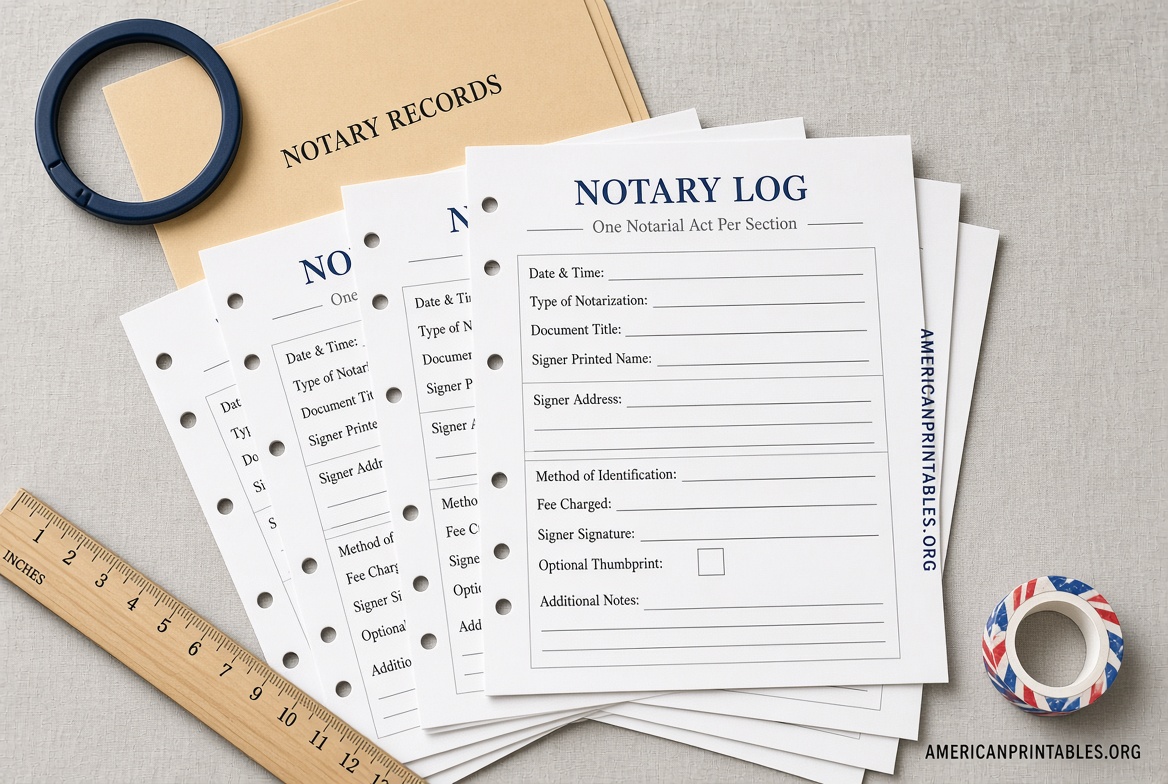
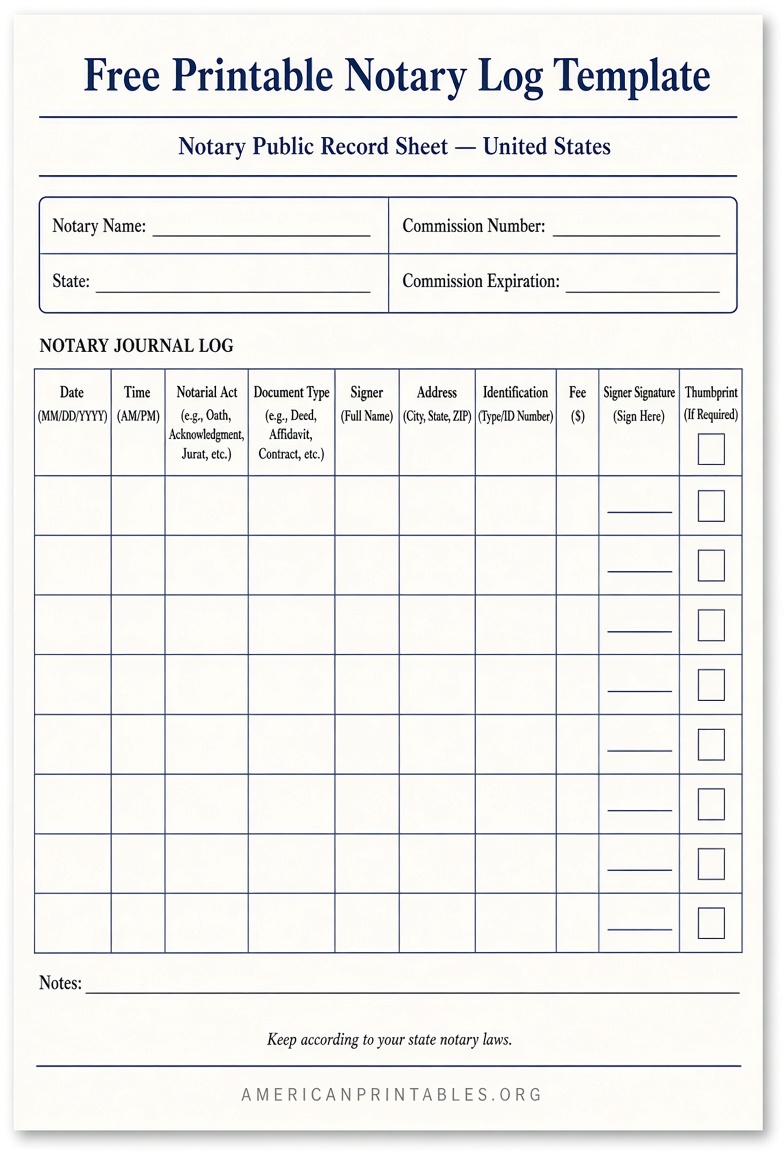
A printable notary log template is a blank page or table you can print and fill in by hand. It usually includes columns or fields for date, time, type of act, document description, signer information, identification method, fee, signature, and notes.
Why U.S. notaries keep a journal?
Journal rules vary by state, but the practical reasons are the same nationwide.
- Many states require a journal for all notarial acts, or at least for remote or electronic acts.
- A complete log can protect you if a document is lost, altered, or disputed.
- It creates a paper trail of identity screening and due diligence.
- It helps you track fees and refused requests.
- Professional standards, including guidance from the National Notary Association, treat a journal as a core part of responsible practice.
Even in states that do not mandate a paper journal for every in-person act, keeping one is still a strong risk-management habit.
What to record on a notary log sheet?
Required fields differ by state. Most U.S. templates include the items below because they match common statutory lists and recommended practice.
- Date and time of the notarial act
- Type of act (acknowledgment, jurat, oath, copy certification, or other)
- Type, title, or short description of the document
- Date of the document, if it has one
- Printed name and address of each signer
- Signer signature or mark in the journal
- How identity was proven (personal knowledge, ID document, or credible witness)
- ID type, issuing agency, and issue or expiration date when an ID is used
- Fee charged, or “no fee” / “$0”
- Thumbprint, if your state requires it for that document type
- Notes on unusual circumstances or why an act was refused
Do not record Social Security numbers, credit card numbers, or other unnecessary private data. Several states expressly prohibit those numbers in the journal.
Complete the journal entry at the time of the notarization, before the signer leaves. Do not backfill entries later from memory.
Printable template vs. bound notary journal
This distinction matters more than the design of the page.
Many states and model notary laws expect a tangible journal to be a permanent, bound register with numbered pages. The point is to make it hard to add, remove, or reshuffle entries. Loose-leaf printouts in a binder may not meet that standard.
A free printable notary log template is still useful when:
- Your state allows or does not specify a bound format
- You want a practice sheet or backup worksheet
- You need extra fields, such as thumbprint or contact details, before buying a bound book
- You are checking which columns your state expects
If your commission is in a bound-journal state, use the printable page as a model, then keep the official record in a bound book with sequential pages. California, for example, requires one active sequential journal under the notary’s exclusive control and sets detailed entry rules in state law and the official handbook.
Where to get a free printable notary log template?
Use sources that show the actual template or download page. The three options below are current starting points. None of them replace your state statute.
1. PandaDoc notary journal template
PandaDoc publishes a free notary journal template with simple table, line-style, and block-style layouts. Fields typically include date notarized, type of notarization, document date and type, signer name and signature, address, identification details, fingerprint/other information, and fee. Open the template page here: PandaDoc free notary journal template.
2. Florida Notary Service printable PDF page
This page offers a landscape letter-size (11 x 8.5 inch) printable notary record page that can be printed as needed and placed in a binder. It includes fields for type of act, type of document, type of ID, contact information, and thumbprint. The publisher notes that some states still require a hardbound book. Get it here: free PDF notary journal template.
3. Official state guidance, not a generic form
Before you print a stack of pages, read your state’s current journal rule. The National Notary Association maintains a free U.S. Notary Reference that is useful for comparing state requirements: NNA U.S. Notary Reference. California notaries should also use the official handbook from the Secretary of State: California Notary Public Handbook.
For line-by-line help on filling each column, use the NNA’s journal-entry guide: A Notary’s guide to completing journal entries.
Paid marketplace listings and bound commercial journals exist, but they are not free. Do not treat an Etsy or Amazon listing as a free official form.
Free Printable Notary Log Template | USA Guide 2026


How to use a free printable notary log template?
- Confirm your state’s required fields and format.
- Download or open one template and print a single test page first.
- Number pages by hand if the file is not pre-numbered.
- Fill the notary identification block (your name, commission number, and expiration date) if the page includes one.
- Record each act on its own line or block, in chronological order.
- Have the signer sign the journal when your state requires a journal signature.
- Take a thumbprint only when the law requires it, commonly for certain real-estate documents or powers of attorney in states such as California.
- Store completed pages securely. If your state requires a bound book, transfer the official record into that book rather than treating loose pages as the legal journal.
- Keep the journal under your exclusive control. Do not leave it with an employer when you leave the job.
- Follow your state’s retention and surrender rules when your commission ends.
Fields checklist for a U.S. notary log book
Use this as a quick audit against any free printable notary journal PDF:
| Field | Usually needed | Notes |
|---|---|---|
| Date and time | Yes | Time of the act, not only the document date |
| Type of notarial act | Yes | Spell out acknowledgment, jurat, etc. |
| Document description | Yes | Deed, POA, affidavit, loan package item |
| Signer name and address | Often | Required in many states |
| Signer journal signature | Often | Required in California and several other states |
| ID method and details | Yes | Personal knowledge, ID, or credible witness |
| Fee | Yes | Write $0 or “no fee” if you charged nothing |
| Thumbprint | State-specific | Required for some documents in some states |
| Notes / refused act | Recommended | Record why an act was not completed |
If a free template is missing a field your state requires, add it in the notes column or choose a different layout.
State rules in brief
Journal law is not uniform.
Some states require a journal for every notarial act. Others require it only for remote online notarization (RON) or electronic acts. A number of states still leave paper journals optional for traditional in-person work, while still recommending a record. Retention periods often run 5 to 10 years after the last entry, and a few states require delivery of the journal to a county clerk or state office when the commission ends.
Because statutes change, treat any national summary as a starting point only. Check your commissioning agency and the NNA state reference before you decide that a printable binder is enough.
Best practices that protect the record
- Use one active journal at a time unless your state expressly allows a separate electronic journal.
- Write in permanent ink.
- Leave no blank required fields.
- Record refused requests and the reason.
- Never let another notary use your journal.
- Keep the journal locked when it is not in use.
- If the journal is lost or stolen, notify the commissioning office when your state requires notice.
- Do not photocopy ID cards into the journal unless your state asks for that evidence.
A clean log will not fix a defective notarization. It will, however, show that you followed a consistent process.
FAQ
Is a free printable notary log template legal in every state?
No. The page layout can be fine, but the format may not be. If your state requires a bound book with numbered pages, loose printed sheets may not count as the official journal.
Can I keep only a digital spreadsheet?
Only if your state allows an electronic journal and the system is secure and tamper-evident. A basic spreadsheet is usually not enough in states with electronic-journal rules.
Do I need the signer’s thumbprint on every entry?
No. Thumbprint rules are state- and document-specific. California requires a right thumbprint for certain real-property documents and powers of attorney. Other states may not require one at all.
Should I record the ID number?
Follow your state. Some states require identifying numbers. Others restrict or prohibit recording certain numbers. Never add a Social Security or credit card number.
How long should I keep the log?
Follow the statute in your state. Where the law is silent, many professional sources recommend keeping the journal for about 10 years after the last entry.
Where should I look if I am unsure?
Start with your Secretary of State or commissioning agency, then compare that text with the NNA journal-entry guide and U.S. Notary Reference linked above.
A free printable notary log template is a practical way to see the fields you need and start recording acts immediately. Use a reputable template, match it to your state law, and switch to a bound official journal whenever your commission requires one.