Free United States History Timeline Printable – A United States history timeline printable is a one-page or multi-page chart that places major events in American history in chronological order. Parents, teachers, and students use it to see how the founding, westward expansion, the Civil War, the world wars, the civil rights movement, and later milestones fit together.
A good printable does more than list dates. It helps a reader answer a simple question: What happened first, and what followed? That is why so many U.S. classrooms and homeschool programs keep a paper timeline on the wall or in a binder.
Below is a practical guide to what these printables include, how to use them, and where to download legitimate free versions. Every link goes to a real resource page or download. None of the linked files are paid products presented as free.
What a U.S. History Timeline Printable Usually Includes?
Most free printables fall into two types.
Filled-in timelines list selected events with dates and short labels. They work well as a study sheet, classroom poster, or unit review.
Blank timelines give dated bands (often by decade) so students add events as they study. These are better for projects, notebooks, and year-long courses.
A useful United States history timeline printable often covers:
- Colonial settlement and early contact
- The American Revolution and founding documents
- The Constitution, early republic, and westward expansion
- The Civil War and Reconstruction
- Industrial growth, immigration, and reform
- World War I, the Great Depression, and World War II
- The Cold War, civil rights, and late 20th-century change
No single free sheet can include every event. Look for a version that matches the grade level and the era you are teaching.
Why Printables Still Matter?
Screens are useful for research. Paper is useful for memory.
A printed American history timeline stays visible during homework, unit tests, and family discussion. Students can color-code wars, laws, inventions, and social movements. Homeschool families can add events over several years and bind the pages into a timeline book.
In 2026, many schools and civic groups are also marking 250 years since 1776. A printed chronology is an easy way to place the Declaration of Independence in a longer American story without turning the page into a souvenir brochure.
Where to Get Free, Legitimate Printables?
These five sources are current, clearly labeled, and appropriate for a U.S. audience. Use them as starting points. Check each page for grade range and printing notes before you hit print.
1. Blank United States history timeline (direct free PDF)
ResearchParent’s blank United States history timeline is one of the most practical free downloads for homeschool and classroom use. It starts with a pre-1600 page, then covers U.S. history from 1600 onward at 10 years per page.
You can choose a horizontal version for binding or a vertical version for a three-ring binder. No email signup is required to download the PDFs. The same site also publishes a related list of important American events that can be added to the blank pages.
This is the closest match if you searched specifically for a United States history timeline printable you can print at home today.
2. Free U.S. history timeline event cards (1490–1900)
TeachingwithJill’s free U.S. history timeline events set on Teachers Pay Teachers includes printable event cards from the 1490s through 1900, plus student recording sheets.
The resource is listed at $0.00. You need a free TPT account to download it. It is aimed at grades 7–11 and works well on a bulletin board: print, cut, and add cards as the class moves through each unit.
Use this if you want ready-made events rather than a blank chart.
3. Library of Congress primary-source timeline
The Library of Congress U.S. History Primary Source Timeline is not a single worksheet. It is the strongest official classroom timeline for American history.
It is organized by era, including colonial settlement, the Revolution, the new nation, expansion and reform, the Civil War and Reconstruction, and later periods. Each section points to primary sources from the Library’s collections.
Print individual pages or source sets for class. Use this resource when you want students to move from a date on a printable to the actual document, map, or image behind it.
4. National Archives milestone documents
The National Archives Milestone Documents list is an official chronological guide to documents that shaped the United States.
It is arranged by era: Revolution and the new nation, expansion and reform, Civil War and Reconstruction, industrial America, the emergence of modern America, the Great Depression and World War II, and the postwar United States. Each entry links to the document and background.
This is the best companion to a printable timeline when you want students to connect a date with a founding text, treaty, amendment, or landmark law.
5. Free customizable history timeline template
PrintNPractice’s free history timeline template is a seven-page printable you can mark by hand or customize before printing. It covers a long span of world history and includes space that families and teachers use for American history.
It is useful if you want one reusable template for U.S. history and world history, or if you prefer to type dates before you print on card stock.
Free United States History Timeline Printable
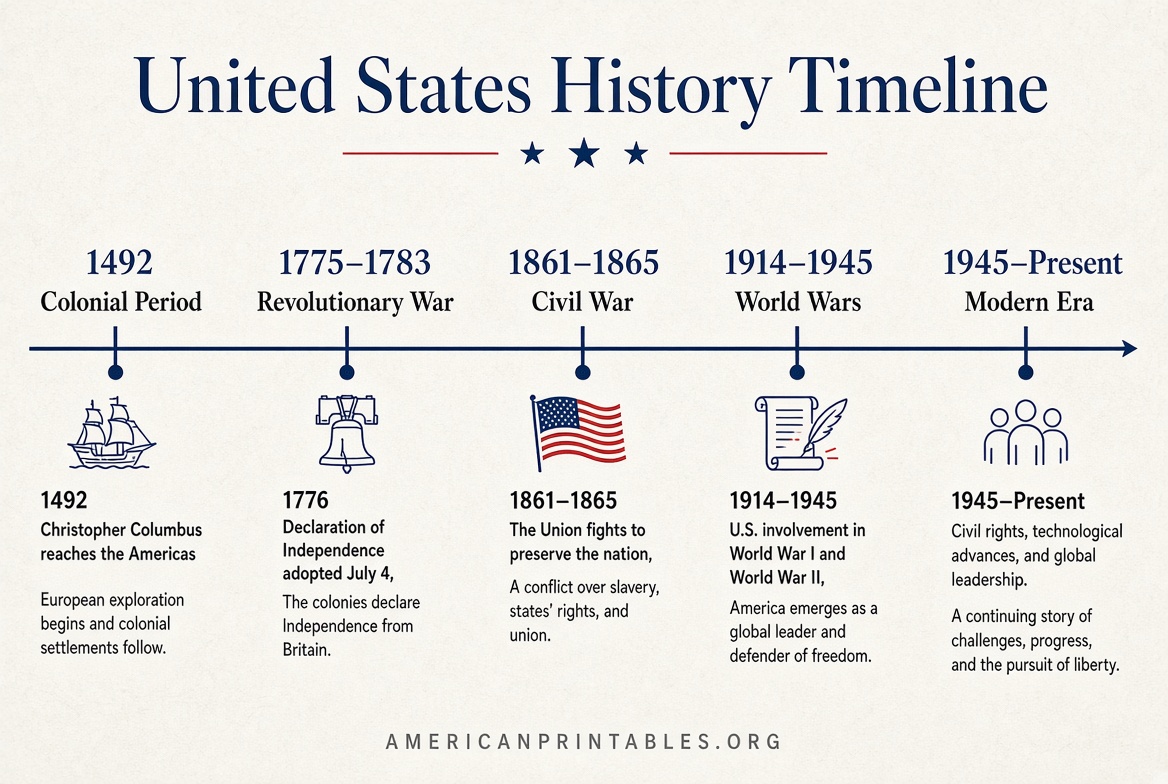
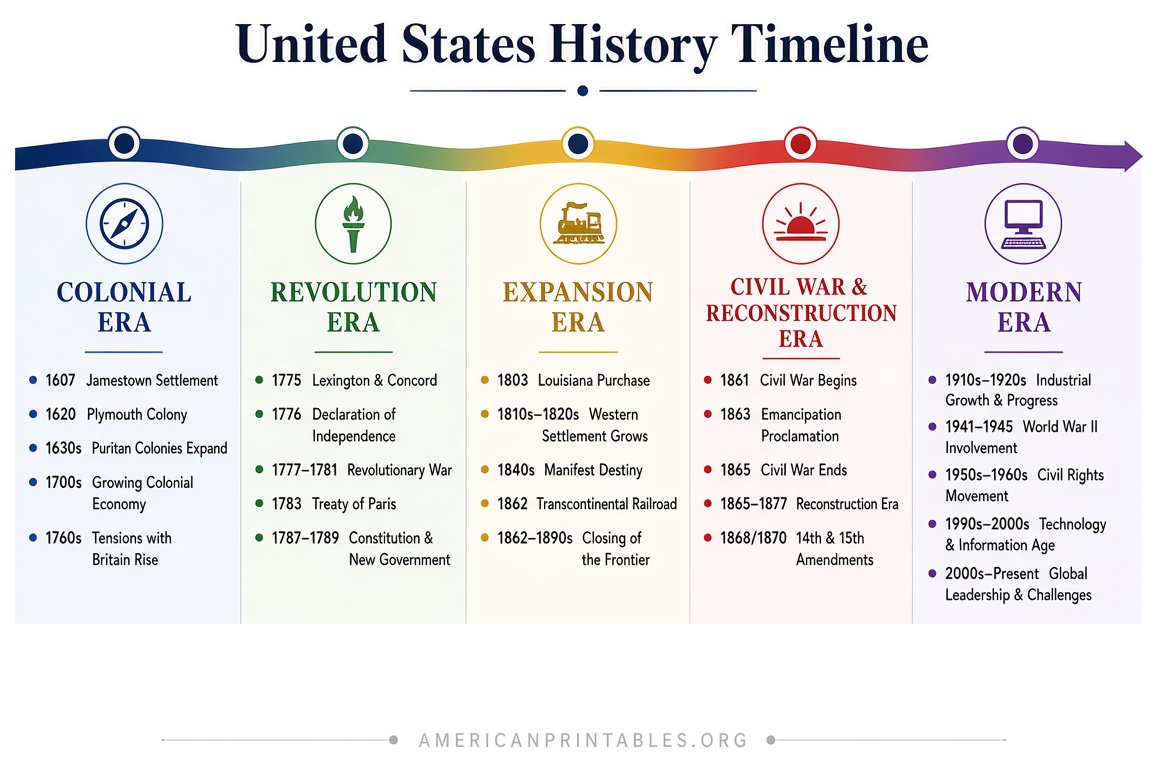
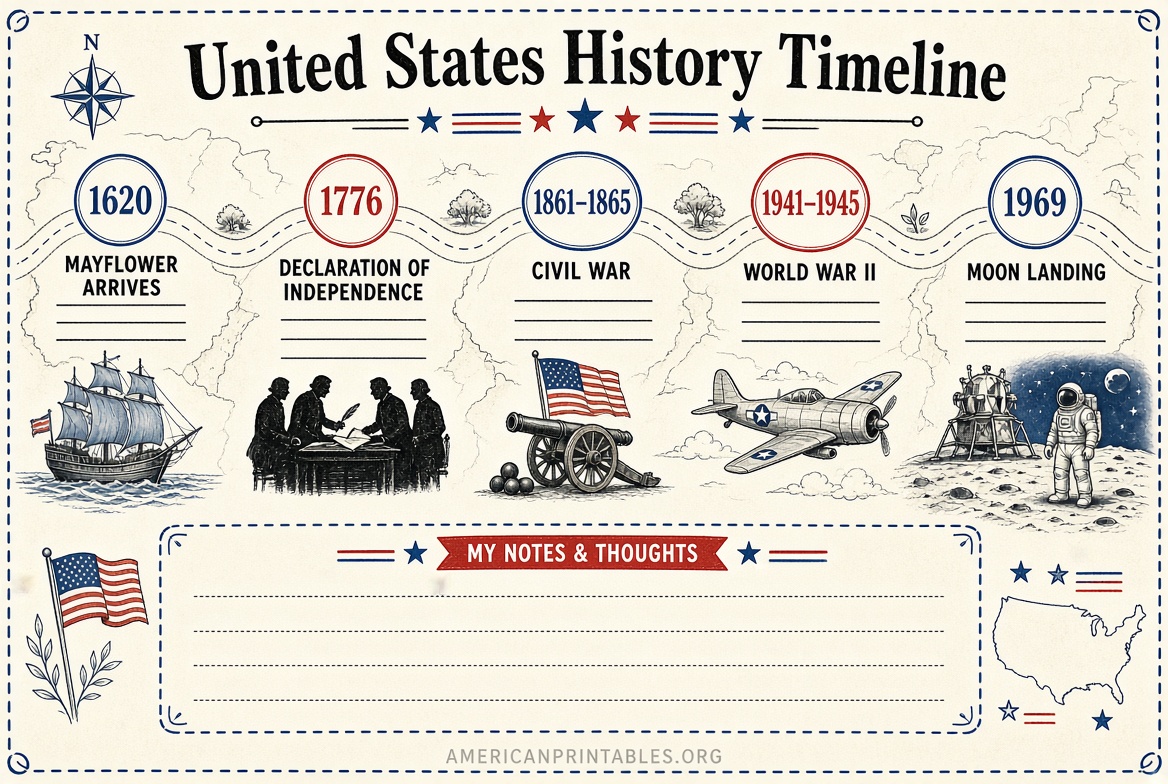
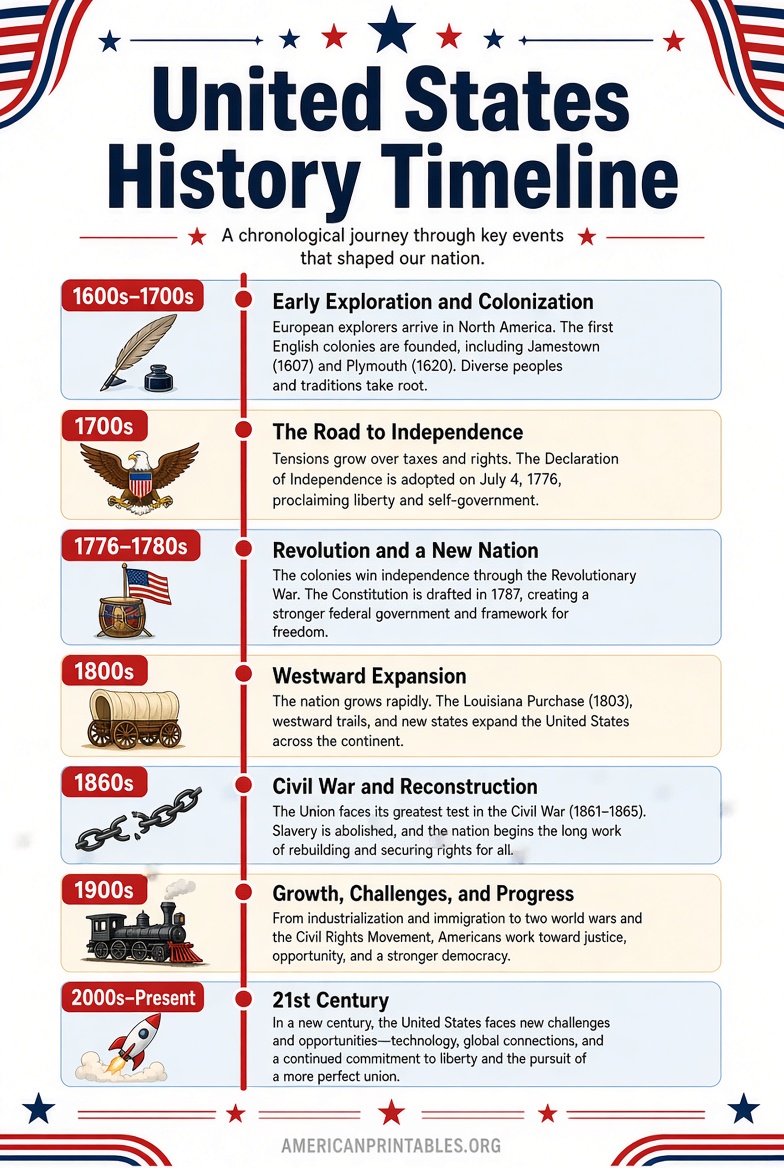
How to Choose the Right Printable?
Match the sheet to the job.
- Elementary: Fewer events, larger type, pictures or color-coding.
- Middle school: One era per page, room for a short note under each date.
- High school: Denser chronology, plus space for causes, effects, and Supreme Court cases.
- Homeschool: Blank dated pages you can keep for several years.
- Classroom wall: Event cards or a long poster-style strip.
Also check the time span. A Revolution-only sheet will not help a Reconstruction unit. A 1490–1900 card set will not cover the 20th century. If you teach a full survey course, combine a blank multi-century timeline with era-specific cards.
Major Eras to Place on a U.S. History Timeline
Use this short outline to decide what belongs on the page. It is a study aid, not a complete national history.
Before 1600. Indigenous nations, early European exploration, and first lasting contacts.
1607–1763. Jamestown, Plymouth, the 13 colonies, and growing conflict with Britain after the French and Indian War.
1763–1789. Resistance, independence, the Revolutionary War, the Articles of Confederation, and the Constitution.
1789–1848. The early republic, the Louisiana Purchase, the War of 1812, Jacksonian politics, and territorial expansion.
1848–1877. Sectional crisis, the Civil War, emancipation, and Reconstruction.
1877–1929. Industrial growth, the West, immigration, Progressive reform, and World War I.
1929–1945. The Great Depression, the New Deal, and World War II.
1945–1991. The Cold War, civil rights, Vietnam, and late-century political change.
1991–present. The post–Cold War United States, technology, and recent civic milestones.
A printed timeline is strongest when each era has a few anchor dates, not a crowded list.
Practical Printing Tips
Print a test page first. Timeline PDFs often use small type.
- Use legal or tabloid paper for wall displays if your printer allows it.
- Print blank pages on card stock if students will write on them all year.
- Leave a margin so hole punches do not cut through dates.
- Color-code categories: government, wars, amendments, technology, and social movements.
- Keep a pencil copy for drafting before you ink a display version.
If you need a large classroom poster rather than a home printout, C-SPAN Classroom has at times offered a free mailed American history timeline poster to people in the United States and U.S. territories. That is a physical poster request, not an instant PDF, so confirm current availability on C-SPAN Classroom before you plan a lesson around it.
How to Use a Printable in Class or at Home?
A timeline worksheet works best as an active tool.
Have students add three events per week instead of filling the whole sheet at once. Ask them to write one cause and one effect under each date. Compare two eras on facing pages. Pair a printed date with one primary source from the Library of Congress or National Archives.
For younger students, cut event cards and place them in order on a table before gluing them onto a blank strip. For older students, require a mix of political, social, and economic entries so the chart does not become a list of wars and presidents only.
Common Mistakes to Avoid
Do not treat a free printable as a complete textbook. It is a map, not the territory.
Watch for sheets that skip Indigenous history, slavery, women’s suffrage, labor, or civil rights. A timeline that only lists presidents and battles will not meet most state social studies expectations.
Do not download random “free PDF” pages from unknown blogs that scrape other teachers’ work. Stick to the official collections and clearly labeled free classroom files linked above.
FAQ
Is there one official United States history timeline printable from the federal government?
No single official one-page PDF covers all of U.S. history. The Library of Congress and National Archives publish the most reliable official timelines and document lists. Teachers usually print those pages or pair them with a blank student timeline.
Are the printables listed here actually free?
Yes. The ResearchParent and PrintNPractice files are free direct downloads. The Teachers Pay Teachers set is listed as a $0 freebie and requires a free account. The Library of Congress and National Archives pages are public government education resources.
What grade is a U.S. history timeline printable for?
Blank dated pages work from late elementary through high school. Dense event lists are better for grades 7–12. Choose fewer events for younger students.
Can I use these printables in a public-school classroom?
The government resources are intended for education. Teacher-created freebies usually allow classroom use; read the license on the download page. Do not sell or republish someone else’s file.
Should I print a filled-in timeline or a blank one?
Print a filled-in version for review and a blank version for the work students do themselves. The blank page is the one they will remember.
A United States history timeline printable is most useful when it stays on the desk, not in a downloads folder. Start with a blank dated chart, add events as you teach them, and use the Library of Congress and National Archives when a date needs a document behind it.