Printable Debits and Credits Cheat Sheet (Free) – A printable debits and credits cheat sheet is one of the most useful quick-reference tools for students, bookkeepers, small business owners, and anyone learning accounting in the United States. It summarizes the core rules of double-entry bookkeeping so you can record transactions correctly without memorizing every detail.
This page explains how debits and credits work, shows the standard rules in plain language, and points you to legitimate free printable resources and download pages.
What Are Debits and Credits?
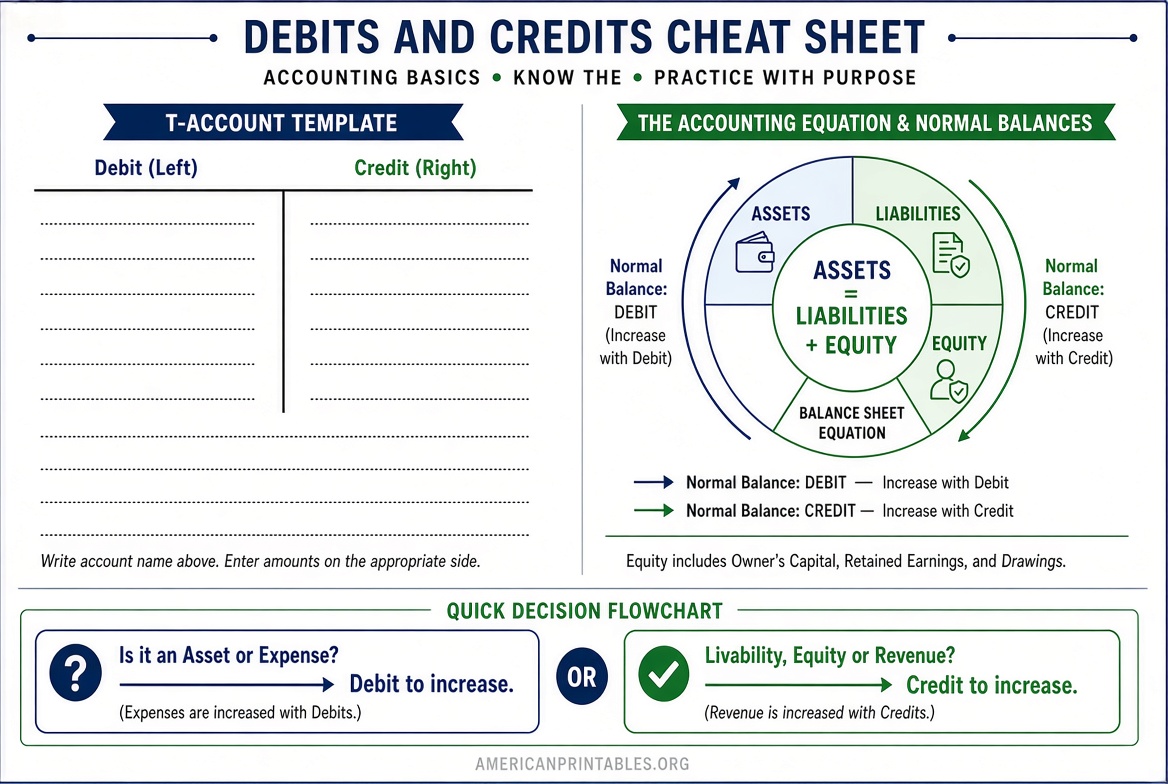
In accounting, a debit is an entry on the left side of an account. A credit is an entry on the right side. These terms do not mean “good” or “bad.” They simply indicate position and direction of change.
Every business transaction affects at least two accounts. The total debits must always equal the total credits. This is the foundation of the double-entry system used across U.S. businesses and taught in American accounting courses.
The basic accounting equation that must stay in balance is:
Assets = Liabilities + Equity
Debits and credits keep this equation balanced with every entry.
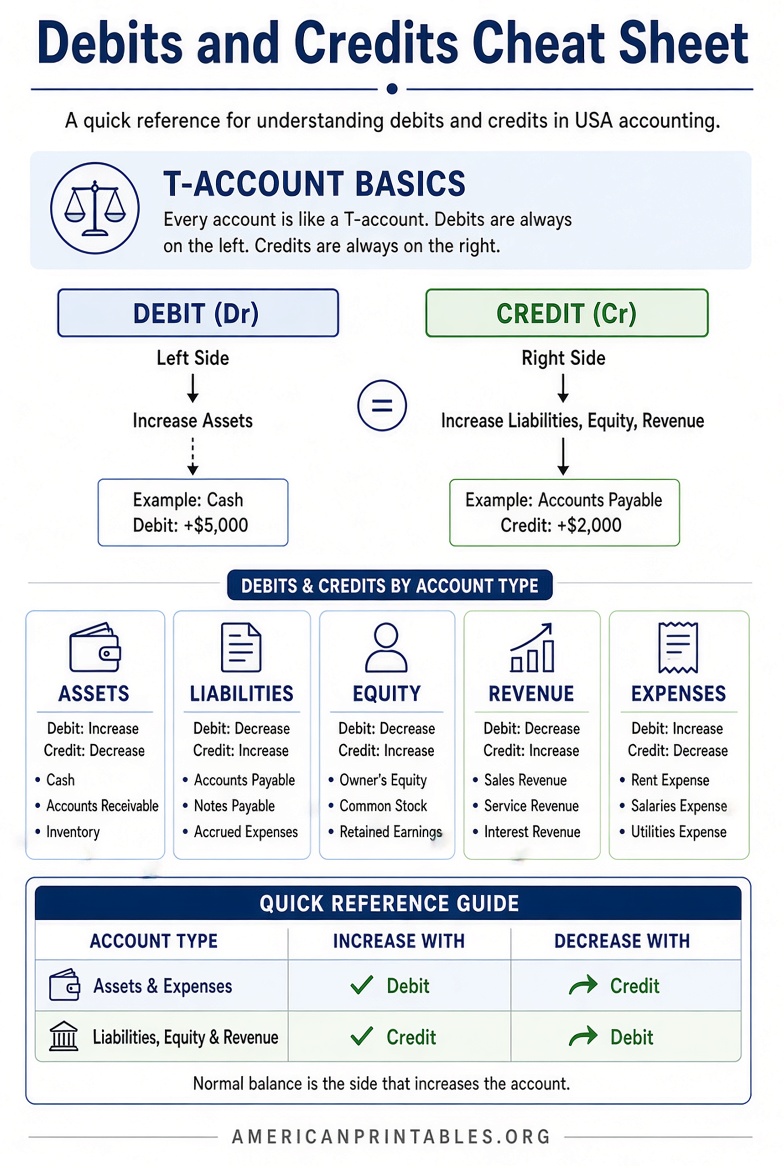
Debits and Credits Rules at a Glance
Here is the standard reference most printable cheat sheets follow:
| Account Type | Debit Effect | Credit Effect | Normal Balance |
|---|---|---|---|
| Assets | Increases | Decreases | Debit |
| Expenses | Increases | Decreases | Debit |
| Dividends/Draws | Increases | Decreases | Debit |
| Liabilities | Decreases | Increases | Credit |
| Equity | Decreases | Increases | Credit |
| Revenue/Income | Decreases | Increases | Credit |
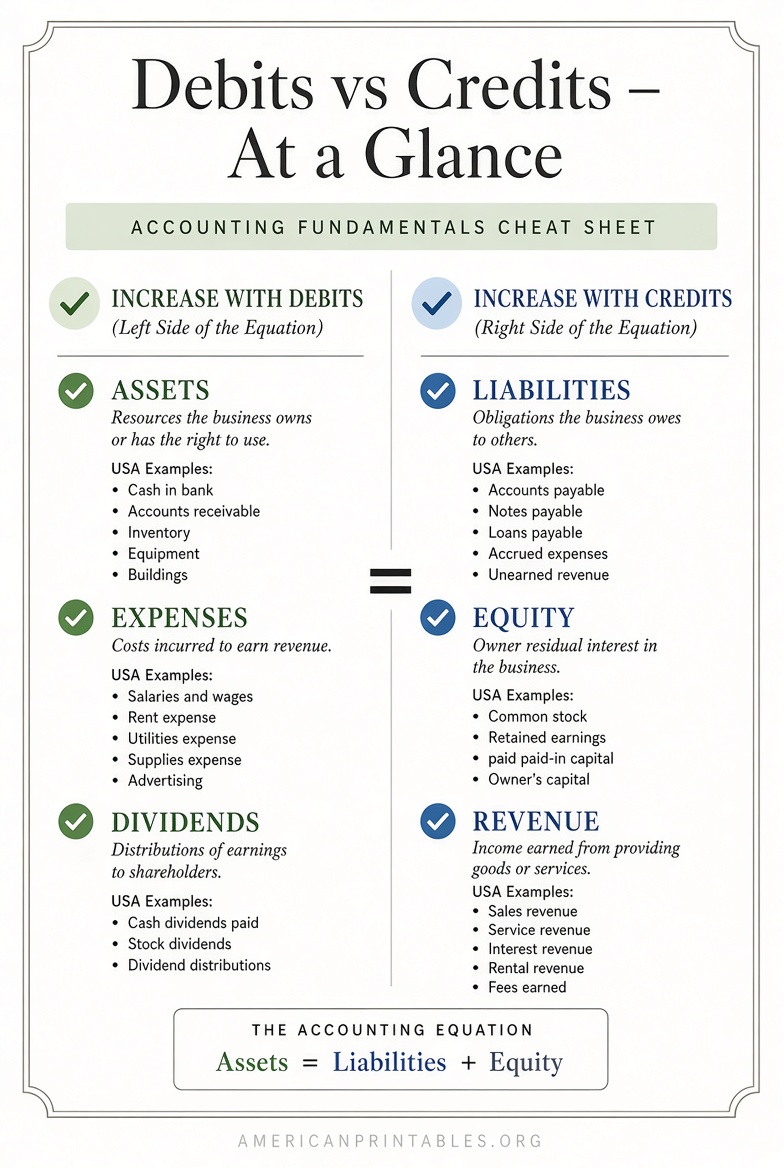
Memory tip used by many U.S. instructors: DEALER
- Dividends, Expenses, Assets increase with Debits
- Liabilities, Equity, Revenue increase with Credits
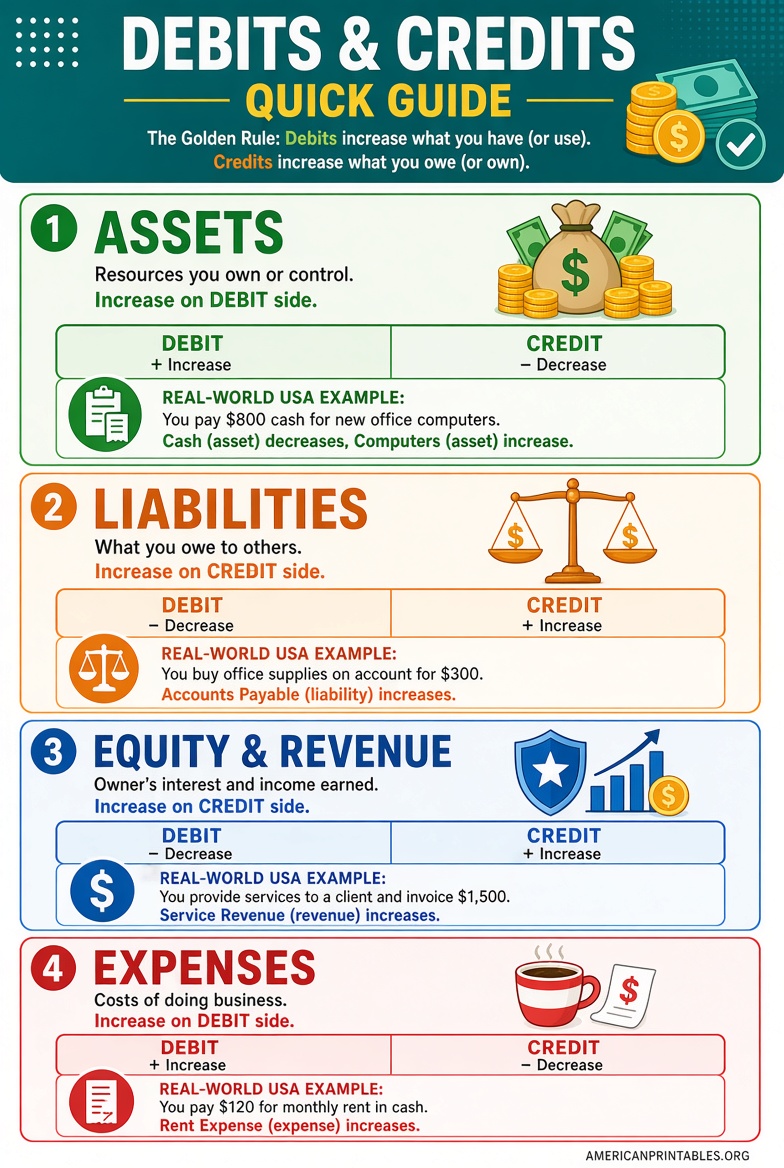
When cash is received, debit Cash. When cash is paid out, credit Cash.
Simple Examples
- You buy $500 of office supplies with cash: Debit Office Supplies (asset) $500, Credit Cash (asset) $500.
- You take a $10,000 bank loan: Debit Cash $10,000, Credit Notes Payable (liability) $10,000.
- You make a $2,000 cash sale: Debit Cash $2,000, Credit Sales Revenue $2,000.
- You pay $1,200 rent: Debit Rent Expense $1,200, Credit Cash $1,200.
These rules apply whether you use paper ledgers, QuickBooks, Xero, or any other system common in the United States.
Where to Get Free Printable Debits and Credits Cheat Sheets?
Reliable free resources (no invented claims of free access):
- AccountingPlay offers direct free PDF downloads of an Accounting Cheat Sheet and a Learn Debits and Credits guide with worksheets. Both are designed for students and small-business use. Download the Accounting Cheat Sheet at this link and the Debits and Credits lessons PDF at this link.
- AccountingCoach provides a free, detailed explanation of debits and credits with real-world examples, T-accounts, and logic you can print or save as a reference. View the free explanation at AccountingCoach Debits and Credits. (Their full dedicated cheat sheet is part of the paid PRO materials.)
- FreshBooks publishes a clear beginner’s guide that includes a ready-to-use debits and credits chart suitable for printing or screenshotting. Read it at FreshBooks Debits and Credits Cheat Sheet.
These sources are established educational or software sites that make the core material freely available. Always download only from the official pages linked above.
Printable Debits and Credits Cheat Sheet (Free)
How to Use Your Printable Cheat Sheet?
Print the sheet and keep it near your desk or in a binder. Many people laminate a one-page version for desk use or add it to study notes. When recording a transaction:
- Identify the accounts affected.
- Decide whether each account increases or decreases.
- Apply the debit or credit rule from the sheet.
- Confirm total debits equal total credits.
Practice with a few sample journal entries until the pattern becomes automatic. U.S. community colleges, high-school accounting classes, and CPA exam prep programs routinely recommend this approach.
Brief FAQ
Do debits and credits have to balance?
Yes. In every transaction the sum of debits must equal the sum of credits. This keeps the accounting equation in balance.
Why does my bank statement show a credit when I deposit money?
The bank views the deposit from its perspective: your deposit increases the bank’s liability to you, so the bank records a credit. On your books the same deposit is a debit to Cash (an asset).
Is a printable cheat sheet enough to learn accounting?
It is an excellent quick reference, but pair it with practice problems or free explanations such as those on AccountingCoach for deeper understanding.
Can I use these rules in QuickBooks or other software?
Yes. The underlying debit and credit logic is the same in every major U.S. accounting system. Software simply records the entries for you once you choose the correct accounts.
A good printable debits and credits cheat sheet removes the guesswork from everyday bookkeeping. Download one of the free PDFs listed above, print it, and keep it handy while you work or study. With consistent use, the rules become second nature.