Spanish Feelings Wheel: Free Printable PDF – A free printable feelings wheel in Spanish helps kids, teens, and adults put words to emotions when English is not the language that feels most natural. In the United States, families, dual-language classrooms, counselors, and Spanish teachers use this tool every day as a rueda de las emociones—a simple chart that turns “I feel bad” into a more precise word like preocupado, avergonzado, or tranquilo.
This page explains what the wheel is, how to use it, and where to download legitimate free printables. Every link below goes to a real download page or official resource. Paid marketplace listings are not presented as free.
What a feelings wheel is?
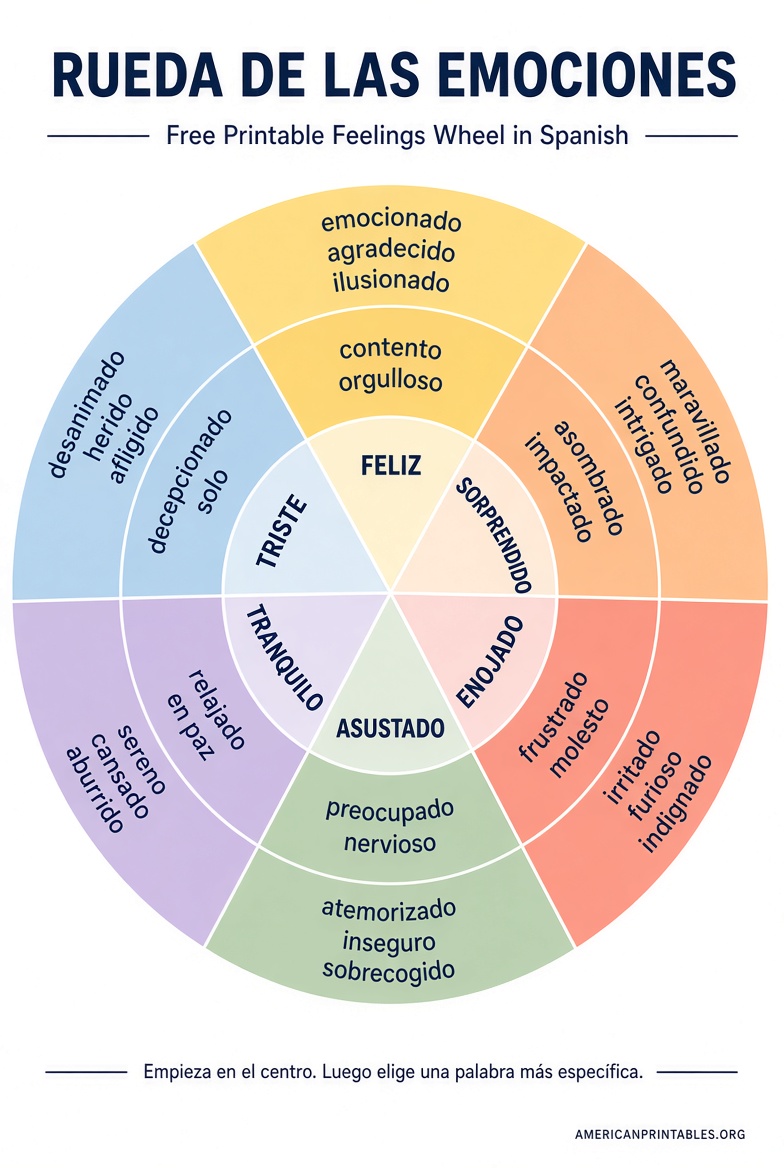
A feelings wheel (also called an emotion wheel or rueda de las emociones) is a circular chart of emotion words. Core feelings sit in the center. More specific words sit in the outer rings.
That layout is useful because people often start with a broad label—triste, enojado, feliz—and then need a closer match. “Sad” and “lonely” call for different support. So do enojado and frustrado.
Two models show up most often in printables:
- Plutchik’s wheel of emotions, which organizes eight primary emotions and their intensities.
- Later “feelings wheel” designs, including versions popularized for counseling and classrooms, with core emotions in the middle and finer words around the edge.
A Spanish feelings wheel is not just an English chart with labels swapped. Good versions use everyday Spanish emotion vocabulary, including gendered adjective endings (contento/contenta) when that matters for language practice.
Why a Spanish version matters in the U.S.?
Spanish is widely spoken in U.S. homes, dual-language programs, and community clinics. Children often feel an emotion in Spanish first, then struggle to name it in English at school. Adults in counseling may do the opposite.
A printable Spanish emotions wheel helps with:
- Social-emotional learning (SEL) in elementary and middle school
- Spanish class vocabulary for estar + emotion adjectives
- Home check-ins with bilingual kids
- Counseling and wellness groups that serve Spanish-speaking clients
- Quiet communication, when pointing at a word or emoji is easier than talking
It is an educational and communication tool, not a diagnosis or a substitute for professional mental health care.
Where to get a free printable feelings wheel in Spanish?
These sources are currently free. Some ask you to open a PDF; one requires a free teacher account. Always download from the official page rather than a random file-sharing site.
1. Understood.org: kid-friendly Spanish wheel with images
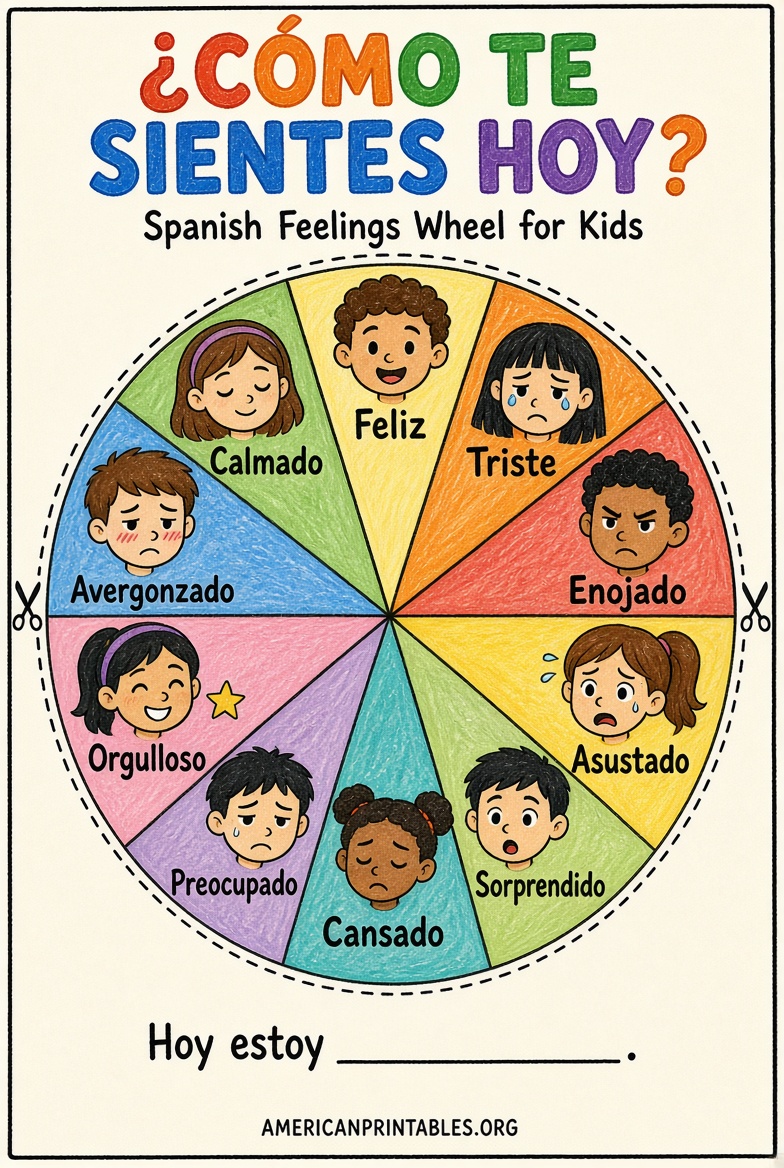
Understood for All is a U.S. nonprofit that publishes family and classroom resources. Its Spanish feelings wheel, La rueda de las emociones, pairs words with simple images so younger children can point even if they cannot read yet. Basic feelings sit toward the center; more specific words sit farther out. The download page also explains how to introduce the wheel during a calm moment, not in the middle of a meltdown.
Get it here: Understood.org Spanish feelings wheel download
Best for: parents, elementary teachers, and support staff working with young children.
2. Feelings Wheel app: full Spanish wheel plus interactive version
Feelingswheel.app/es hosts a Spanish translation of the widely used Geoffrey Roberts feelings wheel. You can explore it on screen, then download a free printable PDF. This version is denser than a kids’ chart. It uses three layers, from core feelings such as feliz, triste, and enojado out to more precise words.
Best for: teens, adults, therapists, and anyone who wants a detailed Spanish emotion vocabulary chart.
3. BEAM Community: Spanish wheel for daily check-ins
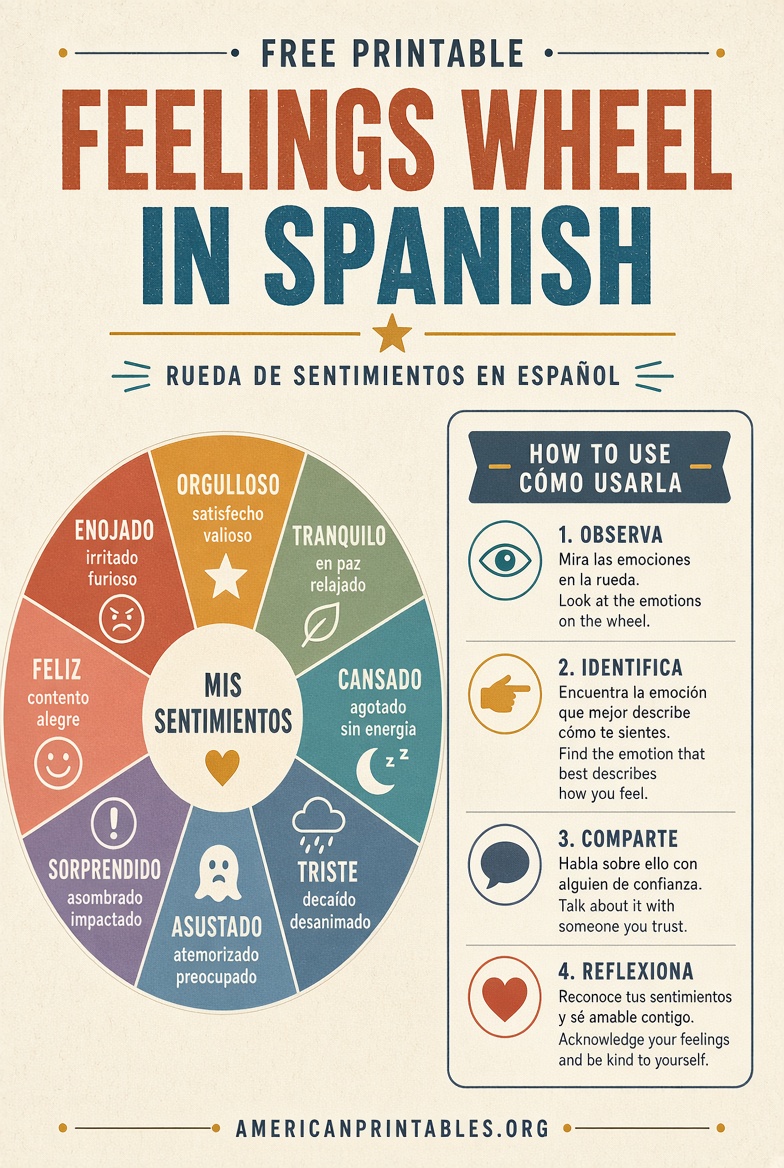
BEAM, a U.S. organization focused on healing and wellness in Black and marginalized communities, offers a Spanish Feelings Wheel with a short, practical guide. The page includes a free PDF download and step-by-step prompts: look at the circle, choose a feeling or color, then ask what that feeling might be saying you need.
Get it here: BEAM Spanish Feelings Wheel
Best for: family check-ins, community groups, and adult self-reflection.
4. Teachers Pay Teachers: free classroom Spanish wheel
Spanish teachers can download a free Rueda de emociones made for language class. It includes masculine, feminine, and non-binary adjective endings and works as a wall chart or handout for practicing ¿Cómo estás? A free TPT account is required. The listing is free to download, but the creator’s license is for the purchaser’s classroom use—do not upload the file to a public website.
Get it here: Free TPT Spanish feelings wheel
Best for: Spanish and dual-language teachers.
5. Canticos: bilingual emotions-wheel craft for young kids
Canticos, a U.S. bilingual kids’ brand, offers a free “Make an Emotions Wheel” activity. Children name feelings in English and Spanish, then draw faces for emotions such as happy, sad, anxious, sleepy, and hungry. It is more of a make-your-own wheel than a finished clinical chart, which is often a better fit for ages 3 and up.
Get it here: Canticos bilingual emotions wheel activity
Best for: preschool, homeschool, and bilingual family nights.
How to choose the right printable?
Match the chart to the person who will use it.
- Pre-K and early elementary: Choose a wheel with faces or emojis and a short word list. Understood and Canticos fit this group.
- Spanish class: Choose a chart that includes adjective agreement. The free TPT wheel is built for that.
- Tweens, teens, and adults: Choose a multi-ring wheel with a larger vocabulary. The Geoffrey Roberts Spanish wheel is the closest match.
- Counseling or wellness groups: Use a detailed wheel plus a simple prompt, such as BEAM’s “What is this feeling trying to tell me that I need?”
If you need both languages, print one Spanish wheel and one English wheel and keep them side by side. That is often clearer than a cramped bilingual poster.
How to print it so it actually gets used?
Use standard U.S. Letter paper (8.5 x 11 inches) unless the file is labeled A4.
- Print in color when the wheel is color-coded by emotion family.
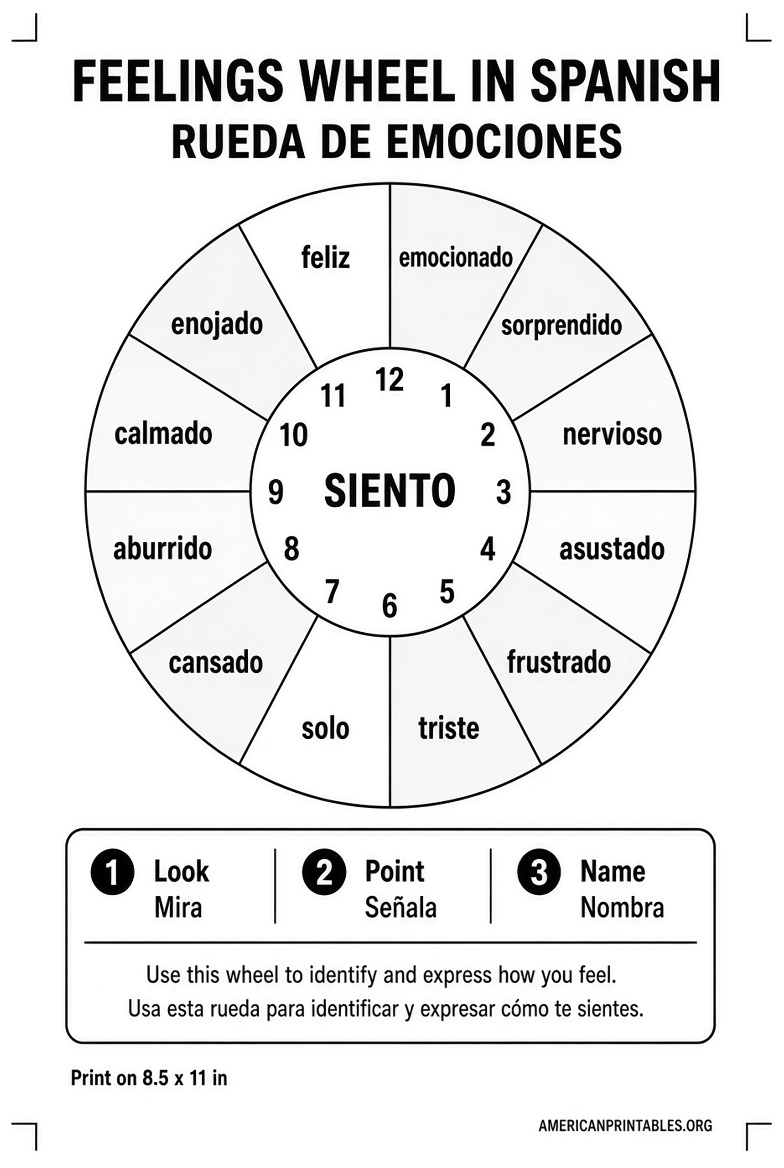
- Print a black-and-white copy if you want kids to color it themselves.
- Use cardstock if the chart will be handled every day.
- Laminate classroom copies and attach them with a magnet or clip in a calm-down corner.
- For a spinner wheel, print two copies, cut the top circle, and fasten the center with a brad.
Skip glossy photo paper for kids’ versions. Fingerprints and dry-erase marker work better on laminate.
How to use a Spanish feelings wheel?
Introduce the tool when everyone is calm. A wheel taught during a tantrum rarely sticks.
At home
- Look at the inner circle first: feliz, triste, enojado, asustado, calmado.
- Ask, “¿Cómo te sientes ahora?” and let the child point.
- Move outward only if they want a more specific word.
- Follow with one practical question: “What would help?” or “¿Qué necesitas?”
In class
- Use the wheel as a morning check-in.
- Practice full sentences: Estoy frustrado porque… / Estoy orgullosa de…
- Compare similar words, such as enojado vs. molesto vs. furioso.
- Let students point instead of speaking if they are overwhelmed.
For adults
Start at the center, pick the closest core feeling, then test two or three outer words. Naming the feeling is the first step. The next step is noticing what the feeling is asking for—rest, a boundary, help, or time.
Feelings can overlap. A child can be contento and nervioso on the same morning. The wheel is a map, not a multiple-choice test.
Free vs. paid: how to avoid the wrong download
Search results for “free printable feelings wheel in Spanish” are mixed with Etsy and similar listings that cost several dollars. Those products can be high quality, but they are not free.
Before you download:
- Confirm the page says free, $0.00, or descarga gratis.
- Prefer nonprofits, education sites, and creator pages that show the file before checkout.
- Avoid random “PDF locker” sites that demand an email for a file they do not own.
- Respect classroom licenses. Free for your students is not the same as free to republish.
If a site only offers a free copy to U.S. practitioners after a request form, that is a limited professional courtesy, not a public printable.
Quick Spanish emotion words you will see on most wheels
These words appear again and again on a free printable feelings wheel in Spanish:
- Feliz / contento(a)
- Triste
- Enojado(a) / enfadado(a)
- Asustado(a)
- Sorprendido(a)
- Cansado(a)
- Preocupado(a)
- Frustrado(a)
- Avergonzado(a)
- Orgulloso(a)
- Solo(a)
- Tranquilo(a) / calmado(a)
- Emocionado(a)
- Aburrido(a)
Regional usage varies. Enojado is common in U.S. classrooms serving Mexican and Central American families; enfadado shows up more in some other varieties of Spanish. Use the word your community actually says.
FAQ
Is a Spanish feelings wheel really available for free?
Yes. The Understood, BEAM, Feelingswheel.app, TPT, and Canticos resources listed above are free as of this writing. TPT requires a free account.
Can I use a free printable in a U.S. classroom?
Usually yes for personal or classroom use, but read the license. Teacher-created TPT files typically cannot be posted on a school website.
What paper size should I use?
U.S. Letter is the default for American printers. If a PDF looks cropped, open the print dialog and set “Fit to printable area.”
Is this the same as therapy?
No. A feelings wheel helps people name emotions. It does not diagnose anxiety, depression, or behavior disorders.
Should I print English and Spanish versions?
Yes, if the child or client switches languages. Two simple charts beat one crowded bilingual page.
A free printable feelings wheel in Spanish is most useful when it stays visible: on the fridge, in a calm-down corner, or in a counseling folder. Download one chart that matches the age of the person who will use it, print it on sturdy paper, and practice during ordinary moments—not only during hard ones.